Olafur Eliasson: Nel tuo tempo
from 24 August 2026
to 24 August 2026
Introduction
Olafur Eliasson: Nel tuo tempo (In your time) responds to the Renaissance architecture of Palazzo Strozzi, immersing the building in light, fleeting shadows, reflections, patterns, and intense colour. For his largest exhibition in Italy to date, Eliasson presents new and old works that call into question the distinction between reality, perception and representation.
Navigating the spaces in the palazzo – the Courtyard, the Piano Nobile, and the Strozzina – visitors encounter installations, minimal interventions, and sculptures that invite them to view the building in a new way.
Palazzo Strozzi becomes a meeting point between the building’s architecture and its history, between exhibitions and visitors, between space and time.
“Nel tuo tempo is a meeting-up of artworks, visitors, and the Palazzo Strozzi itself. This extraordinary Renaissance building has travelled through the centuries to greet us here, now, in the twenty-first century – not as a mere host for art but as a co-producer of the exhibition.
Yet it is not only the Palazzo Strozzi that has travelled across time. As visitors, you too have travelled – each mind–body different from the others. On individual journeys – with diverse backgrounds and experiences – we meet up in the here and now of the exhibition.”Olafur Eliasson
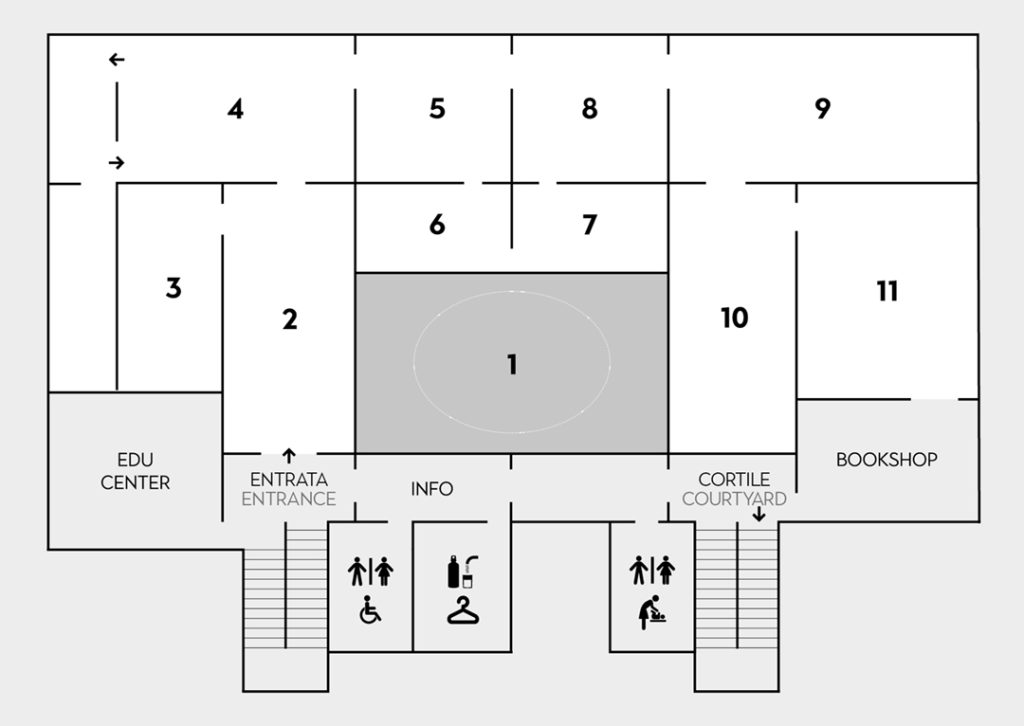
Courtyard

1
Under the weather, 2022
steel frame, printed textile, recycled polypropylene strapping, monofrequency lights
11 x 8 m
Courtesy of the artist; neugerriemschneider, Berlin; Tanya Bonakdar Gallery, New York / Los Angeles
Under the weather is a new site-specific artwork created by Olafur Eliasson for the courtyard of Palazzo Strozzi and the starting point for the exhibition Olafur Eliasson: Nel tuo tempo, which unfolds inside the palazzo, on the Piano Nobile and in the Strozzina. The installation consists of an 11-meter-large elliptical screen hanging at a height of 8 meters. The screen, which appears to flicker and change as visitors move around the courtyard, presents a moiré pattern – an effect that occurs wherever two or more grids or similar patterns are overlaid and clash, interfering with our vision.
The artist offers us an experience that allows us to reflect on perception and movement in relation to the space around us. As we move about the courtyard, the pattern appears to change with our shifting perspectives, interacting with each of us individually and destabilising our perception of the strict, right-angled Renaissance architecture of Palazzo Strozzi.
The installation was made possible thanks to the support of the Fondazione Hillary Merkus Recordati in the context of the Palazzo Strozzi Future Art project.
First floor
2
Triple seeing survey, 2022
3 spotlights, wall mounts
dimensions variable
Courtesy of the artist; neugerriemschneider, Berlin; Tanya Bonakdar Gallery, New York / Los Angeles
Three spotlights on the opposite side of the courtyard shine into the room through the large existing windows, which have been cropped and reframed. As a result, they cast a grid of light onto the wall, conjuring up a set of surrogate windows which magnify the irregularities in the centuries-old glass. As visitors cross the space, they find themselves immersed in a dialogue between artificial and natural light, and between real and projected spaces and openings.
A typical feature of Palazzo Strozzi is the interplay between its interior and exterior space created by the large windows that overlook the courtyard and light its rooms in a way that constantly changes throughout the day. Eliasson intercepts this architectural dynamic with an intervention that purposely uses the physical quality of the glass, its leaden profiles apportioning the light source into squares. The lights reveal the irregularities in the glass, the bubbles, the scratches and the dust, thereby highlighting its texture and allowing viewers to gain an awareness of the glass as the membrane separating the interior from the exterior. This “mediating” surface plays a crucial, protective role but it also permits visual communication.
3
Tomorrow, 2022
3 spotlights, wall mounts, rear-projection screen, colourfilter glass
dimensions variable
Courtesy of the artist; neugerriemschneider, Berlin; Tanya Bonakdar Gallery, New York / Los Angeles
Light projected through the windows of Palazzo Strozzi from a building across the street casts a window-shaped pattern onto a screen that divides the room in two. Special filters attached to the spotlights produce in the projection a colourful fade, from red to yellow, that is reminiscent of a sunset or sunrise.
Visitors entering the room can see the silhouettes and ankles of people on the other side of the screen, but it is not immediately clear how they can access that space until they move to the next room. The work reflects Eliasson’s long fascination with the atmospheric effects of light, translating it into a physical and visual deconstruction of Palazzo Strozzi as an architecture of changing and changeable light, in which visitors are called on to play a leading role.
4
Just before now, 2022
spotlights, wall mounts, mirror foil, rear-projection screen, colour-filter glass
dimensions variable
Courtesy of the artist; neugerriemschneider, Berlin; Tanya Bonakdar Gallery, New York / Los Angeles
A number of spotlights inside the room shine out through the windows onto mirrors just outside the palazzo’s windows. The light bounces off the mirrors and is projected onto a screen inside, where, along with a variety of colours caused by films added to the spotlights, the irregularities of the centuries-old glass become apparent. Different hues emerge depending on the angle at which they are seen: blue from one side, orange from the other. Viewed head on, the colours mix at the centre. The shifting tones drive visitors to move about the room in order to examine the projections from close up, triggering in them a new awareness of the relationship between their bodies, space and light.
5
How do we live together?, 2019
stainless steel, paint (black), mirror foil
476 x 680 x 680 cm; 476 x 952 x 7.6 cm
Courtesy of the artist; neugerriemschneider, Berlin; Tanya Bonakdar Gallery, New York / Los Angeles
A black, semi-circular arc is mounted on a mirror on the ceiling, from which it extends down to touch the floor at a single point. The semicircle visually combines with its reflection to give the illusion of a giant ring traversing the mirror’s surface and uniting the real space of the room with the reflected space. A moment of alienation and disorientation is triggered when viewers recognise themselves floating upside down in the mirror above, sharing the space with the ring that seems to bridge the two worlds.
6
Solar compression, 2016
convex glass mirrors, monofrequency lights, stainless steel, paint (white), motor, control unit, wire
ø 120 cm, 10 cm
Ingebjørg Folgerø and Ådne Kverneland, long-term loan to Stavanger Kunstmuseum
Suspended from the ceiling by a cable, a disc composed of two convex mirrors rotates slowly in the room, causing the reflections of the room and the people in it to be bent and distorted. An array of monofrequency lamps sandwiched between the mirrors shines yellow light out on the surrounding space, saturating the room and reducing viewers’ colour perception to shades of yellow, grey, and black.
7
Red window semicircle, 2008
mirror, spotlight, tripod, colour-effect filter glass (red)
dimensions variable
Ed. 1/3
Courtesy of the artist; neugerriemschneider, Berlin; Tanya Bonakdar Gallery, New York / Los Angeles
A spotlight filtered by a red colour-effect filter glass illuminates a small mirror. The circle of light is cut in half by the mirror, causing one semicircle to appear just below the mirror while the other half is reflected by the mirror and appears, enlarged, at the base of the opposite wall. The resulting semicircle of light resembles a small sunset, and is reminiscent of Eliasson’s celebrated The weather project, shown at Tate Modern in London in 2003.
8
Your timekeeping window, 2022
24 glass spheres
ø 180 cm
Courtesy of the artist; neugerriemschneider, Berlin; Tanya Bonakdar Gallery, New York / Los Angeles
Twenty-four glass spheres arranged in a circle are mounted on a wall covering one of the palazzo’s windows. The light from outside – as well as the view through the window – is now visible only through the spheres, which act as lenses. Through the process of optical refraction, the fragment of exterior space rendered in each of the twenty-four spheres appears upside down, creating a new compound image of the environment opposite the palazzo.
Triple window, 1999
spotlights, tripods, gobos
dimensions variable
Private collection; Courtesy of the artist; neugerriemschneider, Berlin
Creating a dialogue with the site-specific installations presented in the previous rooms, this work from 1999 uses three spotlights to cast overlapping rectilinear patterns onto a wall. The shapes result from gobos – special stencils that are added to theatre and film lights to cast patterns reminiscent of the light shining through a window at night. Because of the relative positions of the spotlights, the projections create an illusion of perspectival depth on the flat wall.
9
Beauty, 1993
spotlight, water, nozzles, wood, hose, pump
dimensions variable
Courtesy of the artist; neugerriemschneider, Berlin; Tanya Bonakdar Gallery, New York / Los Angeles
Bands of coloured light shimmer in a curtain of mist. This apparition depends on the light projected from a precisely angled spotlight, as refracted and reflected by the water droplets, meeting the eye of the viewer. The resulting rainbow changes depending on the viewer’s position; no two viewers see the same rainbow. As Eliasson says: “It is a matter of fluctuating back and forth between two positions: seeing the rainbow, not seeing the rainbow, seeing and not seeing.” Beauty is an articulation of Eliasson’s idea that the viewer is always a necessary co-producer of the artwork.
10
Firefly double-polyhedron sphere experiment, 2020
stainless steel, colour-effect filter glass (green, orange, yellow, cyan, pink), glass mirror, LED light, motor, paint (black)
ø 170 cm
Courtesy of the artist; neugerriemschneider, Berlin; Tanya Bonakdar Gallery, New York / Los Angeles
The geometric structure of this work is the product of decades of research undertaken at Studio Olafur Eliasson. Two complex polyhedrons are embedded one inside the other. The faces of both are made from various tones of iridescent colour-effect-filter glass, a special material that reflects light of a single colour while allowing the remaining tones to pass through. As the inner form rotates slowly around the central axis, the overlapping panes of polychromatic glass yield constantly changing hues. Small LED spotlights mounted on the frame illuminate the centre of the sculpture and are reflected out again through the interstices of the construction. The lights twinkle inside it, firefly-like, in a wide range of colours and cast complex, constantly changing shapes and shadows onto the surrounding space.
Colour spectrum kaleidoscope, 2003
colour-effect filter glass, stainless steel
180 x 75 x 200 cm
Private collection; Courtesy of the artist, Galería Elvira González, Madrid, and neugerriemschneider, Berlin
A hexagonal kaleidoscope made of six different shades of highly reflective colour-effect filter glass is mounted on a stand at approximately eye level. One end consists of a narrow opening. On the opposite side of the kaleidoscope, at the large end, viewers peer in to see their surroundings and the movement of other visitors reflected in a myriad of different colours and facets.
11
Room for one colour, 1997
monofrequency lights
dimensions variable
Angsuvarnsiri Collection
Monofrequency lights mounted on the ceiling of the room emit a narrow range of yellow light, reducing viewers’ colour perception to shades of yellow and black. In the artist’s own words: “The experience of being in a monochrome space of course varies for each visitor, but the most obvious impact of the yellow light is the realisation that perception is acquired: the representational filter, or the sudden feeling that our vision simply is not objective, is brought to our awareness, and with that our ability to see ourselves in a different light.”
The longer the viewers stay in the space, the more they begin to perceive subtle colour distinctions and to correct for the yellowish lighting. Upon leaving, they momentarily perceive a bluish afterimage.
Strozzina
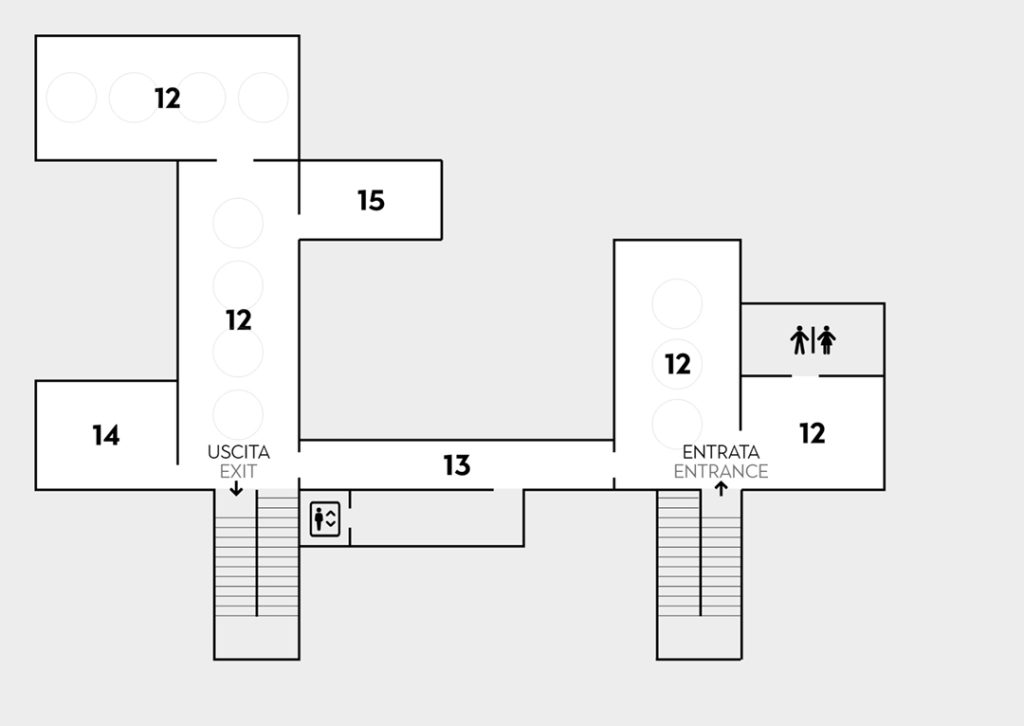
12
Your view matter, 2022
virtual-reality installation, audio
Commissioned by MetaKovan, courtesy of Metapurse
Your view matter uses virtual reality technology to transport visitors through a series of six spaces. Five take the form of Platonic solids, geometrical forms shaped by identical, regular polygons for faces: the tetrahedron, octahedron, icosahedron, dodecahedron, and cube. The sixth and final space is a sphere.
As a user, you explore these spaces from within, one after another, accompanied by a pulsing minimalist soundtrack created by the artist. The walls and ceilings scintillate with everchanging moiré patterns, which may be familiar from print and screens, where stripes or plaids clash with the technology used to transmit the images.
Moirés also occur in the physical world, in meshes, fences, and facades – wherever similar patterns are overlaid. Like in the installation in the courtyard, the patterns in Your view matter change constantly in response to your shifting perspectives. They do not appear unless you move, in the meeting-up of your physical body and the digitally programmed space. The installation can be experienced using the VR headsets in the adjacent spaces. Please ask the gallery assistants for joining the experience.
Beyond the exhibition, where this work is displayed for the first time, Your view matter is minted as an NFT and can be experienced on the website yourviewmatter.art, in both virtual and augmented reality.
This virtual reality installation contains some light patterns and flickering lights that may trigger seizures in people with photosensitive epilepsy or induce motion sickness. Participation is allowed only to persons above 102 cm (3′ 4″) tall. Viewer discretion is advised, especially for, but not limited to, people suffering from high blood pressure or a heart condition, back or neck injuries or related conditions, breathing problems, or sensory sensitivities; pregnant women, people under the influence of alcohol, drugs, or other intoxicants.
13
City plan (hexagonal triangle); City plan (hexagonal wheel); City plan (isometric hexagonal); City plan (isometric pentagonal); City plan (isometric triangle); City plan (rotated hexagonal); City plan (square hexagonal); 2018
all works: glass mirror, paint (black), stainless steel, regional daily newspapers
90 x 90 x 3.5 cm each
Courtesy of the artist; neugerriemschneider, Berlin; Tanya Bonakdar Gallery, New York / Los Angeles
Seven mirror panels are installed in series on a wall, each featuring a different geometric pattern formed by combining eight variables into superimposed pairs. The lines are printed on the outside surface of the glass, so that the patterns and their reflections on the silvered backing, seen through the thickness of the glass, create an optical play. Seven different regional newspapers’ front pages, changed every morning, are displayed on the opposite wall. Across the span of the room, viewers see the range of daily headlines reflected in the mirrors: the shifting flow of information is observed in reverse, visually interwoven with the black lines of the abstract patterns.
14
Fivefold dodecahedron lamp, 2006
copper, semi-transparent mirror, steel, bulb, tripod
190 cm; ø 60 cm
AP II
Courtesy of the artist; neugerriemschneider, Berlin; Tanya Bonakdar Gallery, New York / Los Angeles
The structure in this work, part of an ongoing investigation into the use of five-fold symmetry, is based on the form of a copper dodecahedron. Within this form sits a tetrahedron made of high-reflectivity glass. These two Platonic solids connect at the four corners of the tetrahedron. At the centre of the sculpture, a halogen bulb is suspended. In an interplay of reflection and shadow, interior and exterior, the glass reflects the five-fold pattern when the light is off, while the pattern is projected onto the walls of the surrounding space when the light is on.
15
Eye see you, 2006
stainless steel, aluminium, colour-effect filter glass, monofrequency light
230 x 120 x 110 cm
AP I
Courtesy of the artist; neugerriemschneider, Berlin; Tanya Bonakdar Gallery, New York / Los Angeles
A monofrequency bulb is mounted at the centre of a concave mirror-polished bowl, which emits a bright light. Two dichromatic glass discs installed in front of the bulb change colour according to the viewer’s position and movement. Visitors and surroundings alike are reflected in the glass discs, which also creates a gentle moiré effect.
#NelTuoTempo
Share your images on social medias using the hashtag #NelTuoTempo. Your experience will be included on the Social Wall in the courtyard and on Palazzo Strozzi’s website.