Anish Kapoor. Untrue Unreal
from 24 August 2026
to 24 August 2026
Introduction
With a wide range of early, mid-career and recent works, including a new architecturally scaled work conceived for the Renaissance courtyard, Anish Kapoor. Untrue Unreal offers an opportunity to engage directly with the artist’s oeuvre in all its versatility, discord, entropy and ephemerality. Palazzo Strozzi becomes a venue at once concave and convex, whole and yet fragmented, in which visitors are called on to question their senses.
In Anish Kapoor’s art, the unreal merges with the untrue, transforming or negating the common perception of reality. He invites us to explore a world where the boundaries between what is true and false dissolve, opening the doors to the realm of the impossible.
Kapoor’s works merge empty and full space, absorbing and reflecting surface, geometrical and biomorphic form. Shunning categorisation and distinguishing himself by a unique visual language that embraces painting, sculpture and architectural forms, Kapoor explores space and time, the interior and the exterior, urging us to probe in the first person the limits and potential of our relationship with the world around us and to reflect on perceived dualities such as body and mind, nature and artifice. His work sparks amazement and uneasiness, encouraging us to question certainties and embrace complexity.
Please pay special attention not to touch the artworks on display. Some of the materials may cause permanent stains or irritations to the eyes and skin. The Fondazione Palazzo Strozzi disclaims any responsibility for any damages.
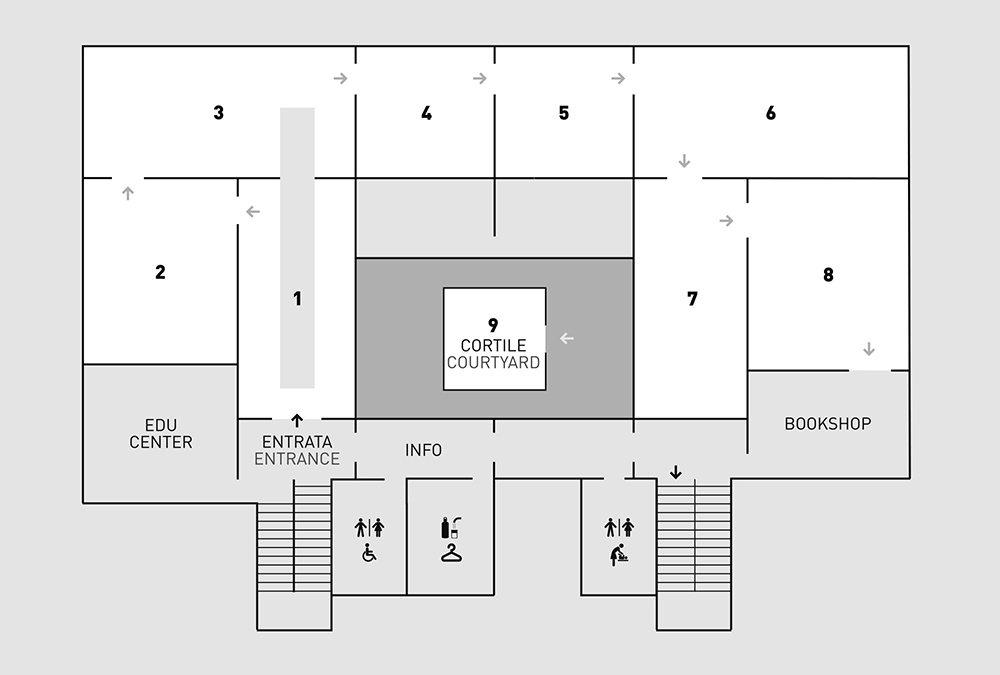
1
Svayambhu, 2007
wax, oil-based paint
The Sanskrit term “svayambhu” defines that which generates itself, which is “self-originated,” and corresponds to Christian acheropite images created without human intervention but miraculously impressed on a material. Just as in these traditional representations, the artist’s intervention is absent, replaced by an invisible motor that moves a monumental block of wax. “The form […] made itself,” and in these “self-generated” works, Kapoor eliminates all traces of human presence or action.
Svayambhu also fosters a dialectical reflection between void and matter. The mass of malleable wax moves on rails along a nearly twenty-meter path between two rooms of Palazzo Strozzi, shaping the material it is composed of in relation to the architecture it pushes through. Along the journey, with an almost imperceptible movement taking half an hour each way, the block of wax leaves traces of a deep red passage, suggesting metaphors of birth while also evoking perceptions of death and violence.
2
To Reflect an Intimate Part of the Red, 1981
mixed media, pigment
To Reflect an Intimate Part of the Red is a seminal sculpture from Kapoor’s early pigment works that established him as a profoundly original voice in contemporary art. It presents a suggestive combination of yellow and red pigment forms that appear to emerge from the floor—fragile, otherworldly, yet powerfully present. While these works differ from subsequent ones in scale, his pre-occupation with the space of the object and its interaction with the architecture it inhabits is already present. In the austere context of Palazzo Strozzi, their chromatic intensity reverberates throughout the space, proving how, in Kapoor’s poetics, color is not just matter and hue but becomes an immersive phenomenon.
Creating this exhibition Kapoor has intervened in the perfect regularity of the building, as he states, “Making an exhibition in these rooms is not easy. Too much order kills the way in which the work can interact with the viewer. It has therefore been necessary to interrupt the order of the rooms by placing works in such a way as to make alternative routes through the building.”
3
Endless Column, 1992
mixed media, pigment
Endless Column references Constantin Brâncuși’s famous sculpture La colonne sans fin (1937). If Brâncuși suggested an upward thrust towards infinity, Kapoor in bringing the architecture of the gallery into play pushes its reach into yet further imaginary realms. The vivid red pigment column that penetrates floor and ceiling breaches the boundaries of the room surpassing the limits of its environment. This creates a sensation of ethereal architectural corporeality—a link between earth and cosmos.
“When you make an object and place pigment on it, the pigment falls to the ground like a halo around the object. And the implication is that it’s like an iceberg: that most of the object is hidden, is invisible. And so I became more and more interested in the invisible object. There was part of it that protruded into the world but the rest was really interesting.” (Anish Kapoor)
4
Non-Object Black, 2015
Untitled, 2023
resin, paint
Dark Brutal, 2023
mixed media, paint
On display from Kapoor’s ground-breaking body of black works is Non-Object Black. Vantablack, the highly innovative material used in this work, is made from carbon nanotubes, able to absorb more than 99.9% of visible light and rendering the contours of the object invisible. The result is the disappearance of the third dimension, allowing Kapoor to bring into question the very idea of the physical and tangible object and to present forms that dissolve in front of your eyes. In these visually astounding works, the artist prompts visitors to wonder about the very notion of being, proposing a reflection not only on the nature of objects but also on the immateriality that permeates our world. Exhibited alongside this sculpture are two recent works that further Kapoor’s exploration of the void object in its potentially paradoxical relationship with what he has termed the ‘proto-object’. In these works we are confronted with a gestation that is full of absence.
5
Gathering Clouds, 2014
fiberglass, paint
cm 188 × 188 × 39 each
The intense experience of the ‘non-object’ from the previous room continues with Gathering Clouds a work composed of four concave monochromes that constitute a poetic symbiosis of Kapoor’s languages of color, mirror, and void. The concave form has frequently been explored by the artist in works that absorb the surrounding space into either meditative darkness or reflective distortion, thereby creating an active space in the foreground in which the viewer might experience a sensation of vertiginous disintegration—what Kapoor has proposed as a ‘contemporary sublime.’ The brooding grays of Gathering Clouds lack a focal point; instead, there is only immersion in the darkness they emit.
6
A Blackish Fluid Excavation, 2018
acciaio, resina
cm 150 × 140 × 740
Tongue Memory, 2016
silicone, paint
cm 250 × 130 × 70
Today You Will Be in Paradise, 2016
silicone, paint
cm 250 × 195 × 45
Three Days of Mourning, 2016
silicone, mixed media, paint
cm 250 × 120 × 70
First Milk, 2015
silicone, fibreglass, paint
cm 180 × 230 × 60
Flesh, organic matter, body and blood are recurring and fundamental themes in Kapoor’s artistic creation. In this room, dramatic eviscerated and devastated intimacies are presented, such as the large sculpture A Blackish Fluid Excavation, evoking a gnarled vaginal void, a form that crosses the space and the senses of the audience. On the wall, Kapoor’s paintings created with silicone are shaped with fluid forms that appear to us as visceral masses, pulsating with their own life. These structures twist, expand, and contract, evoking a sense of continuous movement and transformation. At the same time, a strong tactile sensuality arises from the interplay between softness and solidity, organicity and linearity. These qualities underlie works with evocative titles such as Tongue Memory, Today You Will Be in Paradise, Three Days of Mourning and First Milk. The genesis of these paintings can be found in the wax works that Kapoor began in the early 2000s. He has referred to this body of works as his “phase of blood,” dominated by the color red, a hue that has consistently characterized his art, as it manages to express both life and death.
7
Vertigo, 2006
stainless steel
cm 225 × 480 × 60
Mirror, 2018
stainless steel
cm 195 × 195 × 25
Newborn, 2019
stainless steel
cm 300 × 300 × 300
The notion of boundaries and the duality between subject and object are central to Kapoor’s mirror works like Vertigo, Mirror and Newborn, a work that again pays homage to Constantin Brâncuși’s formal experiments. With their inverted reflections, the specular is thrown into the realm of the illusory in works that seem to defy the laws of physics. These large-scale sculptures reflect and distort the surrounding space, enlarging, reducing and multiplying it, creating a sense of unreality and destabilization while drawing the viewer into the indefinite space they emanate.
“The mirror works, the painted works, they all had skin. […] Skin is the moment that separates a thing from its environment, it is also the surface on which or through which we read an object, it’s the moment in which the two-dimensional worlds meet the three-dimensional world […] There’s a kind of implied unreality about skin which I think is wonderful.” (Anish Kapoor)
8
Angel, 1990
slate, pigment
The exhibition path of the Piano Nobile concludes with Angel: large slate stones covered in numerous layers of intense Prussian blue pigment. These weighty masses appear in contradiction with their ethereal appearance; they seem to solidify the air and suggest the transformation of slate slabs into pieces of sky, transfiguring the concept of purity into a material element.
Kapoor manipulates the hyper-materiality of this work to evoke a sense of mystery that responds to the esoteric ambition of achieving the fusion of opposites. “If art is about anything, then it’s about transformation. It is about changing one state of matter into another. And that happens not by willing it to change, but by some strange process of manipulation which I wouldn’t know how to talk about. I am sure if I were to insist that these forms were quarried blocks of Prussian blue, you’d believe me.” (Anish Kapoor)
9
Void Pavilion VII, 2023
mixed media, paint
cm 750 × 750 × 750
At the center of the courtyard stands a large pavilion that serves as both a point of departure and arrival in the dialogue between Anish Kapoor’s art and Palazzo Strozzi. Upon entering the sculpture, visitors are confronted by a triad of rectangular voids that invite the gaze to descend within, offering a meditative experience of space, perspective and time that unsettles the rational geometric structure of the Renaissance building in which it sits and the orderliness it so emblematically represents.
This experience cannot be fully comprehended through sight alone. It appears to embrace the unconscious of each of us in a world of shadows. It represents emptiness, a well, a physical vertigo of the unknown, the fear of falling, of being drawn into the inscrutability of the past and the future. In a place as strict and controlled as Palazzo Strozzi, Kapoor invites us to contemplate a darkness where we might lose and rediscover ourselves, prompting introspection about our own interiority, about what is real or unreal, true or untrue.
Your feedback is important to us!
We kindly invite you to complete the survey to help us improve. We appreciate your time and opinions.
Thank you!