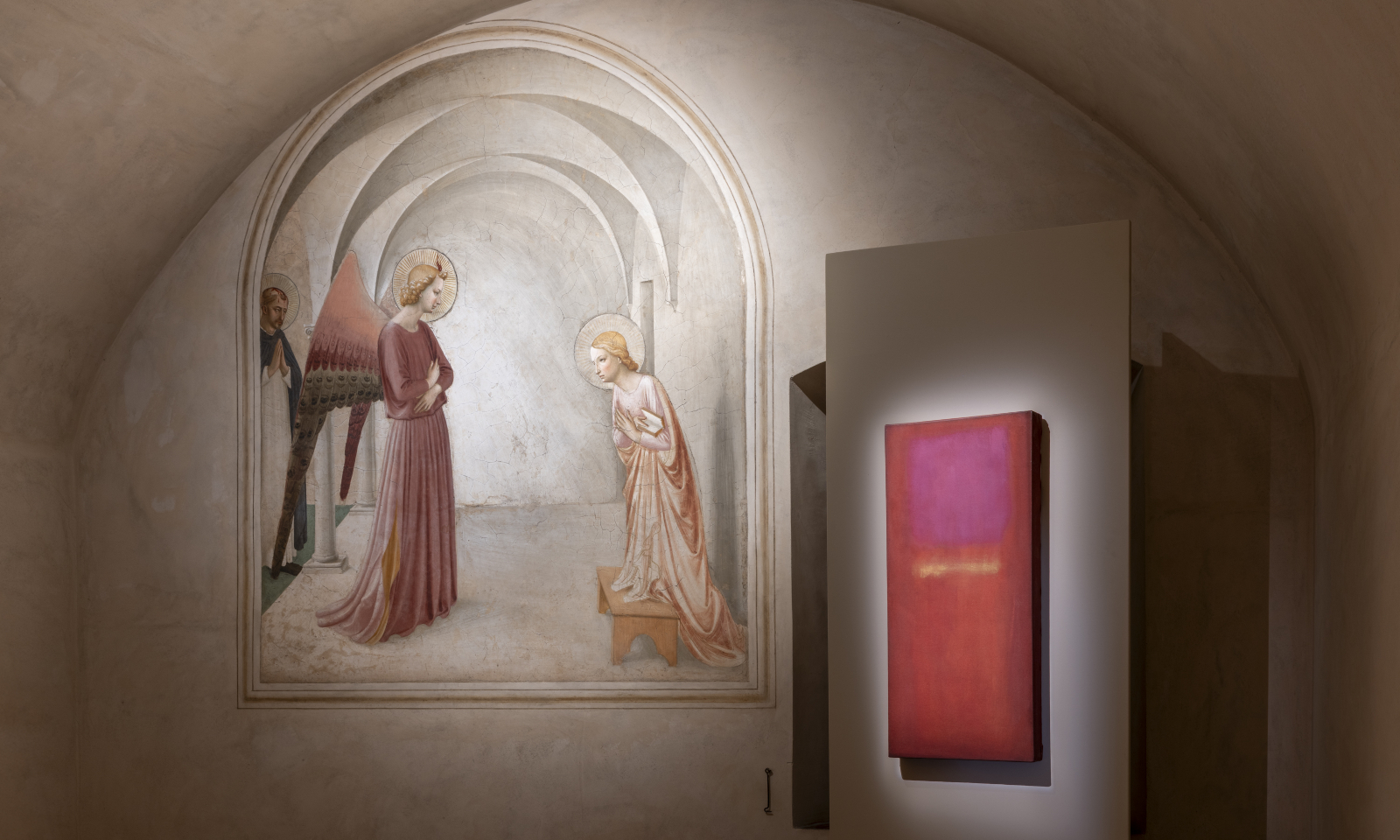
It took me a while to understand why Untitled 1954 by Mark Rothko, placed alongside the Annunciation by Fra Angelico at the Museo di San Marco, affected me so deeply. A physical impact, even. So much so that I stepped back. I have always liked Annunciations. Just as I like the ambushes that good sets. Because good, as we know, lays ambushes. Otherwise it would not be more interesting than evil. Evil is certain in its ends; good is ambiguous. The dazzling angel who appears to a woman who, before not expecting a child, expects no message at all. The angel, like the wolf in Aesop’s fable, stands higher up. He is more colorful, his gaze is resolute, he has peacock wings—at any rate, bird’s wings. If in nature males are more colorful, then angels must have a sex. The woman is penitent; she holds a book of hours in her hand. She looks, like certain dogs, from below upwards, without lifting her head, only her eyes. The angel’s expression is resolute; the woman’s is questioning. The version I prefer most—or perhaps the one I later reconstructed as the first I read—is that of the Gospel according to Luke (1:26–35):
26 In the sixth month the angel Gabriel was sent by God to a town in Galilee called Nazareth, 27 to a virgin engaged to a man whose name was Joseph, of the house of David. The virgin’s name was Mary. 28 And he came to her and said, “Greetings, favored one! The Lord is with you.” 29 But she was much perplexed by his words and pondered what sort of greeting this might be. 30 The angel said to her, “Do not be afraid, Mary, for you have found favor with God. 31 And now, you will conceive in your womb and bear a son, and you will name him Jesus. 32 He will be great, and will be called the Son of the Most High, and the Lord God will give to him the throne of his ancestor David. 33 He will reign over the house of Jacob forever, and of his kingdom there will be no end.” 34 Mary said to the angel, “How can this be, since I am a virgin?” 35 The angel said to her, “The Holy Spirit will come upon you, and the power of the Most High will overshadow you; therefore the child to be born will be holy; he will be called Son of God.”
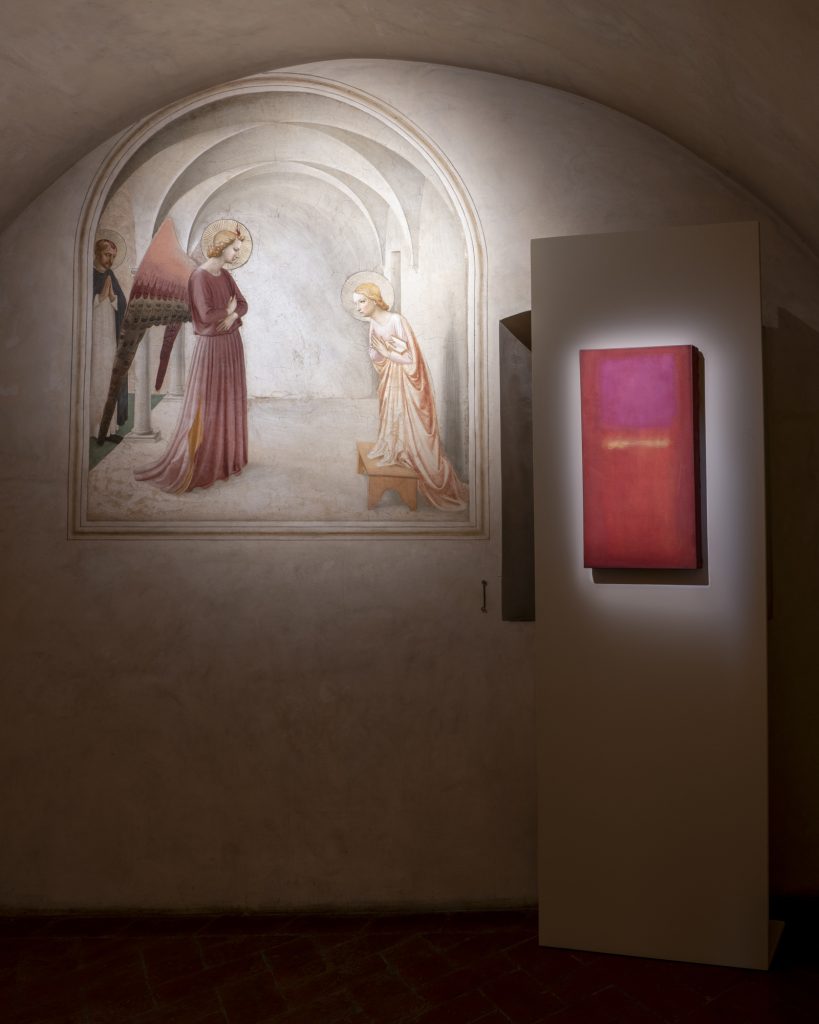
Fra Angelico, with assistance, Annunciation, c. 1439–41, dormitory, cell 3, Museo di San Marco, Florence. Mark Rothko, Untitled, 1954, Private collection. (Rothko a Firenze, exhibition views, Museo di San Marco, Firenze, 2026. Photo Ela Bialkowska, OKNO Studio)
The angel does not announce light; he announces shadow. That shadow may be what befits the essential is a later consideration. But first comes the shadow. I have always thought of that eighteenth-century tale of a young man who, in order to have enough money to ask for the hand of the girl he has fallen in love with, sells his shadow to the devil—and of course this proves fatal. One cannot live without a shadow, writes Adelbert von Chamisso in the 1810s, while the debate on the nature of light—particle or wave?—was raging. One cannot be born without a shadow, the Gospels proclaim. Thus the virgin of Nazareth, who has never known a man, yet has the courage—or perhaps the urgency, or perhaps simply the necessity—to ask questions, will be overshadowed. Good lies in ambush, and the Holy Spirit looms. Oxymoronic verbs, when set against an idea of good and light too simple to be effective. After all, light brings shadow with it. Franco Battiato, in 1991, in the song L’ombra della luce, will make this explicit:
Perché le gioie del più profondo affetto O dei più lievi aneliti del cuore Sono solo l’ombra della luce
For the joys of the deepest affection or of the faintest yearnings of the heart are only the shadow of light (translation by the editor)
Thus, in cell 3 of the dormitory at the Museo di San Marco, the Madonna and the angel have stood facing one another since the late 1430s: he announcing the shadow, she awaiting it. Good without shadow resembles evil—this is what the Gospels say. Good is ambiguous, the Gospels tell us. Good is not a good intention; it is a shadow. And so, with all this—and perhaps more—unfolding in my mind before the juxtaposition of the Annunciation and the red Untitled, vertical, with a shadow of gold at its center, I understood why I had stepped back, why I had been shaken, struck. Because red leaves women as it becomes flesh. And yet, in this conception of shadow, the red remains. That blood-red of Mark Rothko that holds the Madonna within this light of human beings even as the shadow of God seizes her.
Chiara Valerio (Scauri, 1978) is a writer. Among her works, she has published with Einaudi «La matematica è politica» (2020), «Così per sempre» (2022), «La tecnologia è religione» (2023). Her latest novel, published by Sellerio, is «La fila alle poste» (2025). With «Chi dice e chi tace» (Sellerio, 2024), she was a finalist for the Premio Strega. She works at the publishing house Marsilio, is a columnist for the newspaper La Repubblica, and writes for Vanity Fair Italia and d (La Repubblica). Her books have been translated into many countries. She produces and hosts programs for Rai Radio 3 and holds a PhD in probability theory.
Bibliography: D. Derossi, Decidono le femmine. Evoluzione e bellezza maschile, Torino, Einaudi (2025) A. von Chamisso, Storia straordinaria di Peter Schlemihl e altri scritti sul doppio e sul male (Milano, Garzanti, 2002, a cura di L. Bocci) La Sacra Bibbia, Vangelo di Luca, Nuova Edizione Riveduta, laparola.net F. Battiato, Come un cammello in una grondaia, Emi (1991)
On the cover: Fra Angelico, with assistance, Annunciation, c. 1439–41, dormitory, cell 3, Museo di San Marco, Florence. Mark Rothko, Untitled, 1954, Private collection. (Rothko a Firenze, exhibition views, Museo di San Marco, Firenze, 2026. Photo Ela Bialkowska, OKNO Studio).