Mark Rothko was not only a great painter, but also an acute thinker on the status of painting and, more broadly, on the nature of art. For example:
When one begins to reflect on the nature of art, I have never been able to find a rhetoric or symbols more evocative than those of the Greek gods (…) Indeed, in their functions, the Greek gods were able to codify both the qualities and the possibilities of human expression, as well as its limits (…) It seems that the role of the artist is to investigate and to provoke, risking destruction as the price to be paid for having violated a forbidden land. Few escaped annihilation and returned to tell what had happened (…) And it should be remembered that what can be wrested [illegible] from the gods depends on stratagems, which can neither be transmitted nor learned, because one cannot deceive the gods twice in the same way. I hope this explains my infatuation. To ask what can be wrested away and how it can be made available – because, like a stolen jewel of great value, it can only be displayed under certain disguises and conditions1…
These lines open onto a reflection that is, in some sense, endless. Indeed, the reference to the symbolic universe of the Greek gods is confirmed by several works on display in the exhibition at Palazzo Strozzi. Rothko, in a certain sense, reiterates the traditional interpretation according to which the artist knows, on the one hand, that he must respond to the call of an excess, of a daemon, which surprises and summons him, and that he therefore cannot refrain from acting and reaching out his hand. On the other hand, and always at the same time, he is also aware of the dramatic nature of such a gesture. He is aware, against all sentimentalism and romanticism, against the easy enthusiasms that accompany the many rhetorics of art, that the excess that inhabits and unsettles him, and that through his work he strives to inhabit, is “a forbidden land” whose violation always implies “a price to be paid”: the hand that must be extended constantly risks being burned.
This is why, the American painter observes, in undertaking such an adventure, “stratagems” are necessary. In order to “wrest” and “make available” something of what, each time, risks engulfing and destroying, one must arm oneself with discipline: “few escaped annihilation and returned to tell what had happened”. We are at the opposite pole from the comforting and narcissistic conception of the work of art as the expression of a supposed egoic interiority, one “entirely full”, inhabited by no otherness, within which one toys with terms such as “intuition”, “inspiration”, “expression”, “emotion” and “empathy”.
I have never thought that painting has anything to do with self-expression. It is a communication about the world to someone else (…) Any teaching centred on self-expression in art is wrong and has more to do with therapy. Knowing oneself is valuable so that the self may be removed from the process. I insist on this point because the idea that the process of self-expression itself entails many virtues is still widespread. But producing a work of art is another matter (…) I prefer to convey a vision of the world that does not entirely belong to myself. Self-expression is boring. I want to speak of what is foreign to myself – a vast field of experience (…) Self-expression often conveys inhuman values2.
One must therefore proceed, but always “with caution”; one must hold back and, in a certain sense, even protect oneself, without however abdicating, fleeing, or renouncing. The hand, indeed, must be extended, “risking destruction”, but also avoiding destroying:
Apollo might be the God of Sculpture. But he is also, above all, the God of Light; in a flash of splendour, not only is everything illuminated, but, as the intensity increases, everything is likewise annihilated. This is the secret I use to contain the Dionysian in a blaze of light3.
Perhaps Rothko’s painting is nothing other than the magnificent enactment of such an act of containment, and thus, only in this way, also of revelation, through which it seeks to give a place to what escapes and exceeds, to a “flash of splendour” before which one always risks being blinded. The “containing” of which the artist speaks therefore reveals itself as a form of that “welcoming” which, doing everything possible not to “destroy / destroy oneself”, refers in an essential way to the “safeguarding” proper to “dwelling”, at least in the sense in which this gesture, that of dwelling, is understood within the biblical tradition4. It is no coincidence that, in this regard, some scholars, in interpreting the large canvases of the American painter of Jewish origin, have referred to the term shekhinah, whose literal meaning is precisely “dwelling”, “remaining” or “in-being”, to use a Heideggerian term already encountered. Without being able to address such a complex theme here5, I will simply recall a passage from Scholem’s study:
This term, extraordinarily widespread in Talmudic literature perhaps as early as the first century before the Common Era or the century that followed, does not appear in the Bible or in non-rabbinic literature (…) In the sources in which it is attested, this word is used to indicate not just any dwelling, but exclusively the “dwelling” of God. It does not designate the place where God dwells, as it is sometimes explained, which in Hebrew would be mishkan, an expression often used in the Old Testament for God’s dwelling in the tent or in the Temple. The “dwelling” of God, his Shekhinah in the literal sense, rather means his being in a certain place, his visible or even invisible presence. This may manifest itself in a supernatural splendour – so much so that one often speaks of the “light (ziw) of the Shekhinah” (…) [It] is not a hypostasis separate from God himself (…) The Shekhinah is always God himself, God insofar as he is present in a given place or in a certain event. In other words, we are dealing with a designation of God, expressed in hyperbolic images, which stands at the boundary, or at the point of transition, towards hypostatisation6.
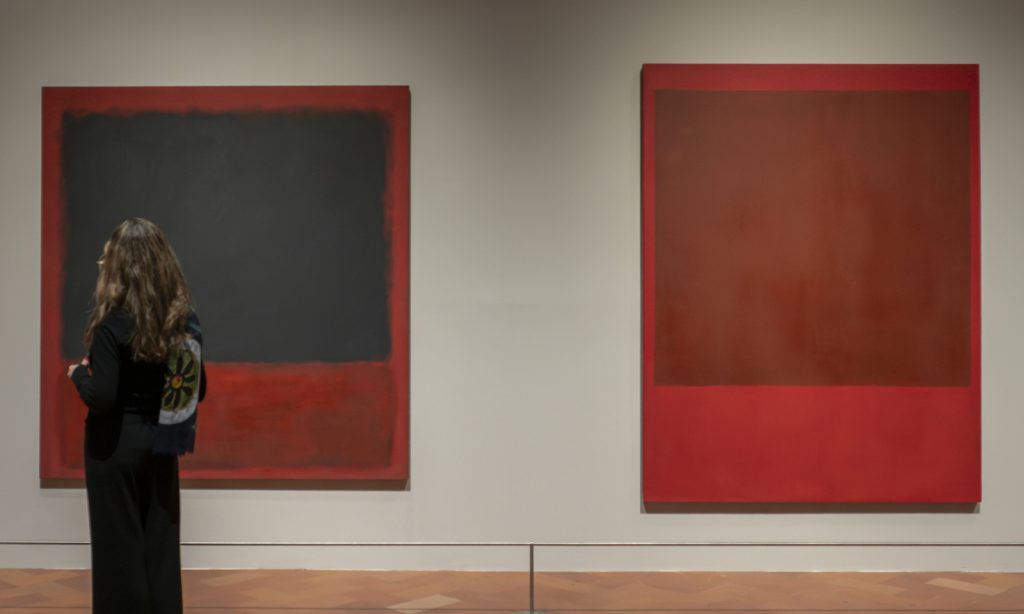
Thus, it is certainly a matter of something present, of an immanent reality that is found “in a certain place”; it is a “place of welcoming” (feminine) within the reach of human beings, a splendour they can sustain, a light they can look upon, and which nevertheless insistently points back to what exceeds every presence, every boundary, every representation. In other words, one could say that it is a matter of hosting and thus exposing what “can only be displayed under certain disguises and conditions”; but one could also say that it is a matter of manifesting and revealing, although always in the double sense of “unveiling, showing” and of “covering over, veiling again”, as if it were always also a matter of protecting and protecting oneself before that which, called upon to manifest itself, risks blinding and annihilating at every moment. Thus returns the theme of dwelling as proper to that human being who is in turn inhabited by an excess / otherness that he cannot measure or master, but that at the same time he cannot ignore. A human being who, for this reason, is an inhabited inhabitant, as art, precisely, so surprisingly reveals. Rothko, in the wake of biblical wisdom, repeated this several times: one must certainly act, operate, one must know how to cultivate, without ever forgetting, however, that one must also safeguard:
Some artists want to tell everything, as in the confessional. I am a craftsman and prefer to say little. My paintings are in fact façades, as they have been called. Sometimes I open a door and a window, at other times two doors and two windows. I proceed with caution. Greater force is conveyed by saying little than by saying much7.
This text draws on part of a broader reflection developed in Silvano Petrosino, Abitale l’arte. Heidegger, la Bibbia, Rothko, Interlinea Edizioni, Novara, 2011.
Silvano Petrosino (Milan, 1955), Professor of Theoretical Philosophy, has taught at the University of Rome Tor Vergata, the University of Calabria and, since 1998, at the Università Cattolica in Milan. He has also taught Anthropology of the Sacred at the Istituto Superiore di Scienze Religiose in Milan. His most recent publications include: “L’idolo. Teoria di una tentazione. Dalla Bibbia a Lacan” (Mimesis, 2015), “Emmanuel Levinas. Le due sapienze” (Feltrinelli, 2017), “Contro la cultura. La letteratura, per fortuna” (Vita e Pensiero, 2017), “Il desiderio. Non siamo figli delle stelle” (Vita e Pensiero, 2019), “Piccola metafisica della luce. Una teoria dello sguardo” (Vita e Pensiero, 2021), “Le fiabe non raccontano favole. Una difesa dell’esperienza” (Vita e Pensiero, 2023), and “Potere e religione. Sulla libertà di Dio” (Vita e Pensiero, 2025).
- Mark Rothko, Écrits sur l’art. 1934-1969, Flammarion, Paris 2005, ed. it. ed. it. cura di di Riccardo Venturi, Scritti sull’arte. 1934-1969, Donzelli, Roma 2007, pp. 153-154. ↩︎
- Ivi, pp. 177-180. «Il lettore che s’imbatte in Artist’s Reality [un manoscritto di Rothko redatto tra il 1939 e il 1941, trovato per caso nel 1988] ha a che fare innanzitutto con un libro teorico, senza alcun riferimento biografico. Christopher Rothko sottolinea peraltro che suo padre non utilizza mai il pronome singolare “io”» (Miguel López-Remiro, «Presentazione», in Mark Rothko, pp. IX-XVI, citazione p. X). ↩︎
- Ivi, p. 200. ↩︎
- Vale la pena ricordare, a tale riguardo, il passaggio del Genesi dove si afferma: «Il Signore Dio prese l’uomo e lo pose nel giardino di Eden, perché lo coltivasse e custodisse» (Gn, 2, 15). Secondo questa concezione, «abitare» significa «coltivare-e-custodire», laddove il coltivare non deve mai dimenticarsi di custodire, così come il custodire non deve mai limitarsi a ripetere e conservare. Su questo grande tema rinvio a Enrico Garlaschelli, Silvano. Petrosino, Lo stare degli uomini, Sul senso dell’abitare e sul suo dramma, Marietti 1820, Genova-Milano 2012. ↩︎
- Un’ampia trattazione dell’argomento si trova in Gershom Scholem, Von der mystischen Gestalt dei Gottheit. Studien zu Grundbegriffen der Kabbala, Suhrkamp Verlag , Berlin 2010, trad. it. La figura mistica della divinità. Studi sui concetti fondamentali della Qabbalah, Adelphi, Milano 2010, a cura di Saverio Campanini, si veda in particolare il capitolo intitolato «Shekhinah. la componente femminile della divinità» (pp. 123-172). ↩︎
- Scholem, pp. 129-130. ↩︎
- Rothko, p. 178. ↩︎
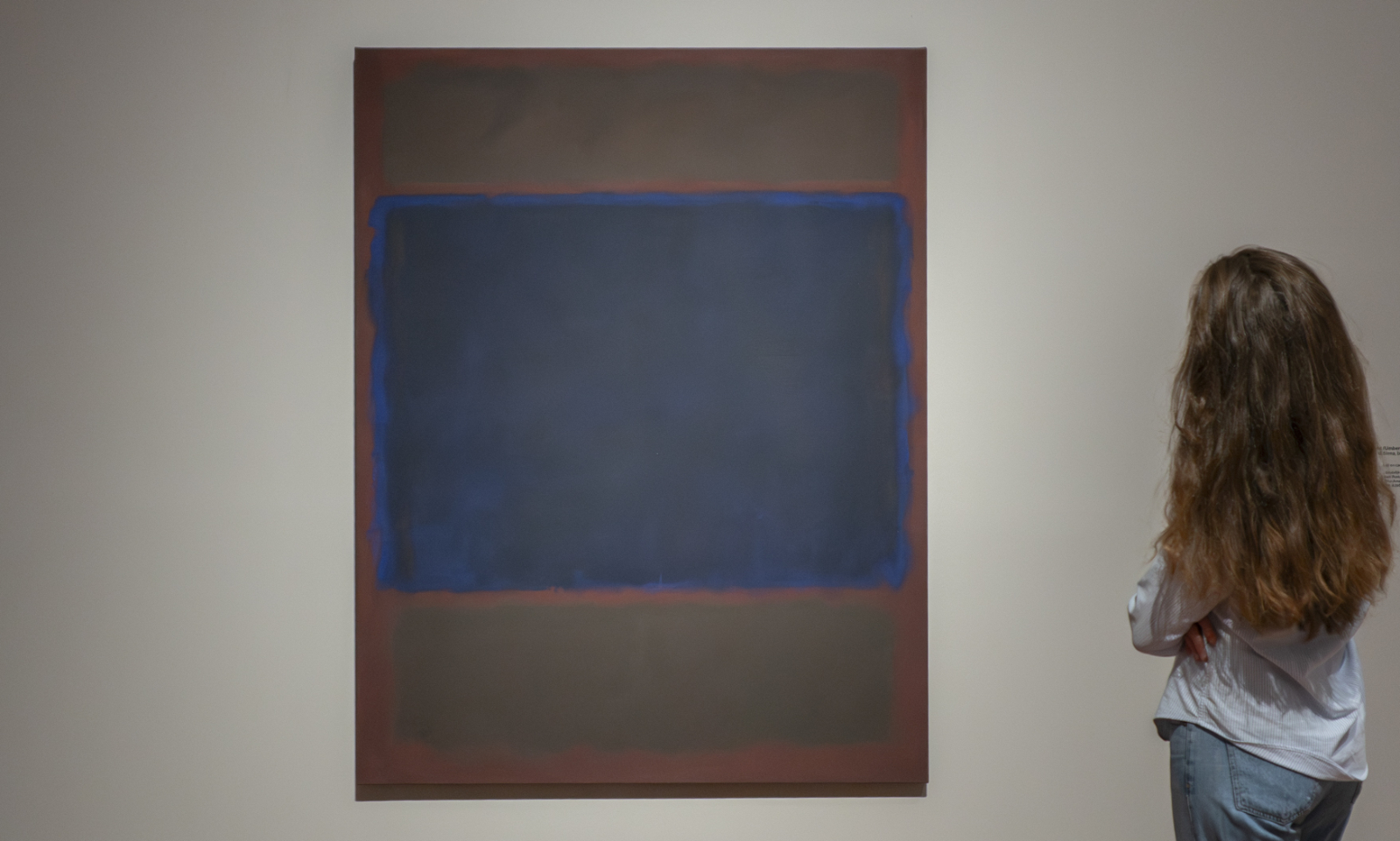
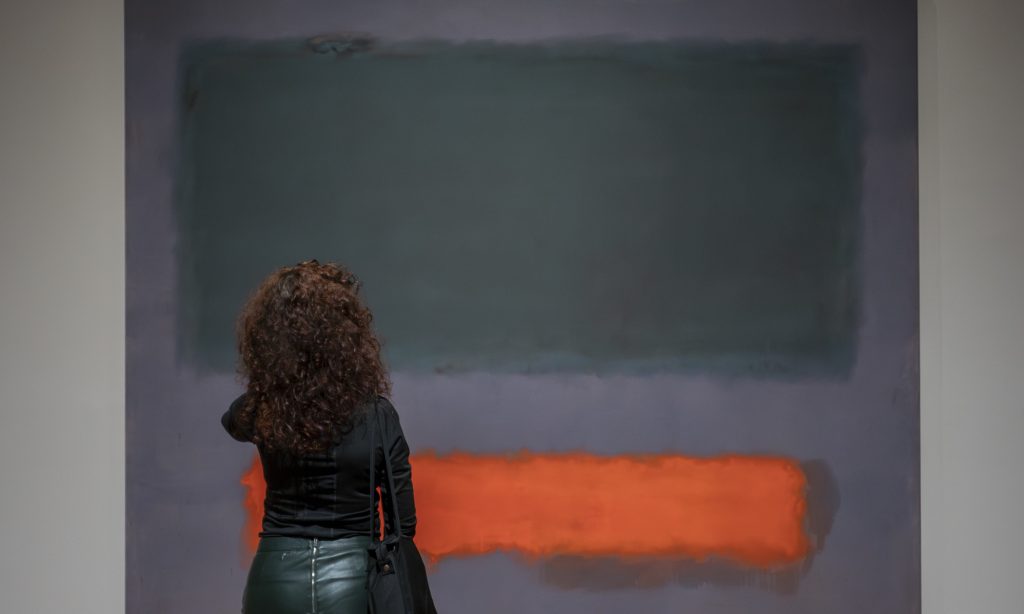
On the cover: Rothko a Firenze, exhibition views, Palazzo Strozzi, Firenze, 2026. Photo Ela Bialkowska, OKNO Studio