Anselm Kiefer. Fallen Angels
from 10 March 2026
to 10 March 2026
Introduction
Palazzo Strozzi presents a major exhibition dedicated to one of the greatest masters of 20th and 21st century art: Anselm Kiefer. The celebrated German artist presents new and historical works that engage in a profound dialogue with the Renaissance architecture.
The theme of the “fallen angels” becomes the starting point of the exhibition: a journey through allegories and forms that reflect on the relationship between spirit and matter, memory and the present, myth and history, through the imaginative power of Kiefer’s art. The exhibition includes painting, sculpture, installation and photography, immersing the visitors through a layered fusion of references, images and quotations ranging from ancient history to the Second World War, from classical philosophy to modern literature, in a profound reflection on human nature, its conflicts, its contradictions and its potentialities.
Through the bold use of different media and techniques, Kiefer creates imposing and evocative works thanks to their strong physical and tactile presence, establishing an immediate connection with the viewer. Works feature materials such as seeds, plants, plaster, metal, and gold leaf, along with phrases and texts, creating dense stratifications that constantly reveal new details and meanings of the works. Words, figures and different materials blend together, evoking a strongly poetic dimension and a profound sensory attraction for the observer, provoking both thought and emotion.
“Rubble is like the blossom of a plant; it is the radiant highpoint of an incessant metabolism, the beginning of a rebirth.” Anselm Kiefer
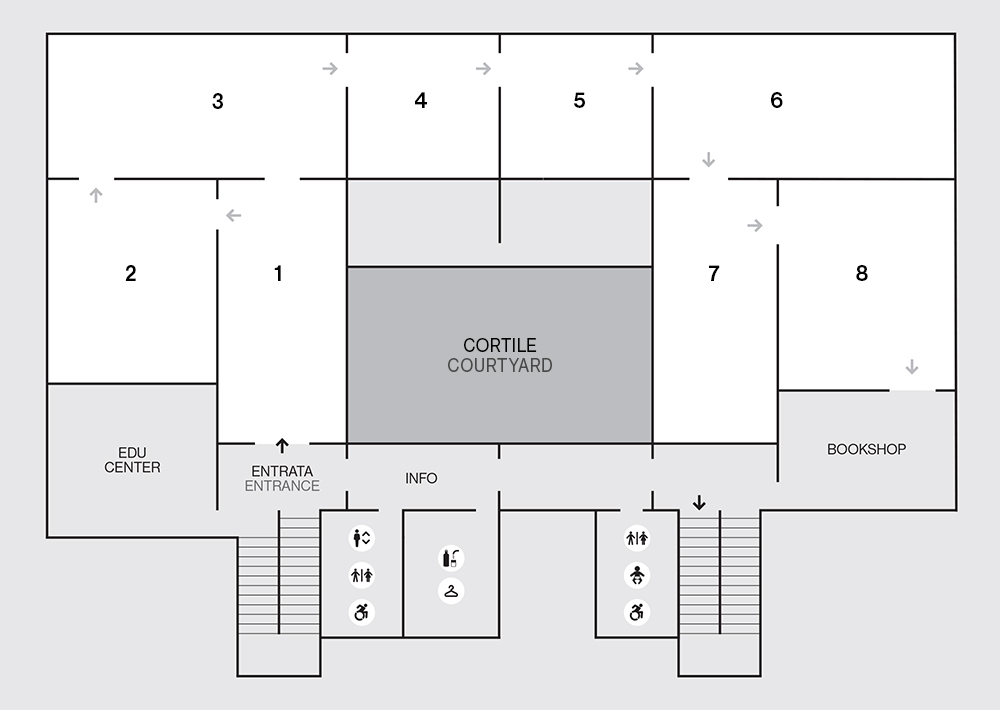
COURTYARD
Engelssturz, 2022-2023
emulsion, oil, acrylic, shellac, gold leaf, fabric, sediment of electrolysis and charcoal on canvas
The exhibition begins with Engelssturz (Fall of the Angel), especially created for the courtyard of Palazzo Strozzi. The painting dialogues with the palazzo’s Renaissance architecture, emphasizing the fusion of tradition and contemporaneity.
For the central figure of this large canvas, Kiefer draws inspiration from the works of Luca Giordano (1634-1705). The title Engelssturz is inscribed at the top left, while “Michael” is written in the Hebrew alphabet (מיכאל) on the right. The rebel angels are driven out of heaven by the archangel, holding a sword in his right hand. His left index finger points skyward, revealing his name. Michael stands out prominently against the gold ground, akin to the metaphysical world expressed in 14th century paintings, as the former angels plummet into obscurity, where they acquire three dimensions.
The work becomes a reflection of the struggle between Good and Evil, as well as an invitation to reconsider the relationship between heaven and earth, between the spiritual and material dimensions. The expression “fallen angels” takes on a greater significance, as it includes all human beings.
1
Luzifer, 2012-2023
emulsion, oil, acrylic, shellac, gold leaf, sediment of electrolysis, fabric and photographic print on paper on canvas
“Fallen angels” constitute a leitmotif throughout the exhibition and is evident in Luzifer (Lucifer). An airplane wing emerges from the canvas, while Lucifer falls toward the bottom, where the angels that have preceded him appear in the form of empty tunics. With these three-dimensional items of clothing, a recurrent element in Kiefer’s works, the artist explores the duality between the spiritual essence of the soul and its material incarnation, emphasizing that “fallen angels” traverse the boundary between the spiritual and the material. The title is inscribed in German on the left, while the word מיכאל, on the right and under the wing, signifies Michael.
The juxtaposition of the angel’s wings with those of airplanes, which have enabled humanity to take to the sky, suggests a double meaning: both are positive symbols as well as emblems of death and destruction.
In Kiefer’s work, wings also allude to the myth of Icarus, which represents human beings’ desire to surpass their limits and the choice to ignore and defy danger. They reveal the tragic consequences of this challenge, becoming a symbol of an aspiration destined to fail.
2
Für Antonin Artaud: Helagabale, 2023
emulsion, oil, acrylic, shellac, gold leaf, sediment of electrolysis, plaster, terracotta and steel wire on canvas
SOL INVICTUS Heliogabal, 2023
emulsion, oil, acrylic, shellac, gold leaf and sediment of electrolysis on canvas
Sol Invictus, 1995
emulsion, acrylic, shellac and sunflower seeds on burlap
Since the 1970s Kiefer has dedicated works to Marcus Aurelius Antoninus, known as Heliogabalus, a young and controversial Roman emperor of the third century who attempted to impose the Syrian cult of the sun god Baal as the state religion but was assassinated by his praetorians. The title Für Antonin Artaud: Helagabale refers to the novel Héliogabale ou l’anarchiste couronné (Heliogabalus: Or, The Crowned Anarchist, 1934) that playwright and director Antonin Artaud (1896–1948) devoted to the young emperor.
With gold backgrounds and giant sunflowers, Kiefer recalls solar cults, celebrating the triumph of light over darkness and the Sol Invictus (Unconquered Sun) in which solar deities of various beliefs merged.
The woodcut Sol Invictus embodies the cyclical conception of time and life: sunflower seeds fall on the figure (the artist). The sunflower, a tribute to Van Gogh, ties in with the thought of Robert Fludd, a 17th-century English philosopher and alchemist, who associated each plant with a star, thus creating a link between the earthly and celestial worlds according to an idea that can be traced back to Plato.
3
La Scuola di Atene, 2022
emulsion, oil, acrylic, shellac, gold leaf, sediment of electrolysis, fabric and canvas collage on canvas
Vor Sokrates, 2022
emulsion, oil, acrylic, shellac, gold leaf, sediment of electrolysis and canvas collage on canvas
Vor Sokrates, 2022
emulsion, oil, acrylic, shellac, gold leaf, sediment of electrolysis, fabric, lead and canvas collage on canvas
Kiefer has stated that “painting is philosophy,” and this discipline that has always permeated his work as an artist, thinker, and researcher. These three recent large-format canvases depict figures of ancient philosophers, following the path of the evolution of thought over time.
The Presocratics, who lived between the seventh and fifth centuries BC, are included by Kiefer in a sort of family tree in the work Vor Sokrates (Before Socrates, 2022). They include Archimedes, Anaximander, Anaximenes, and Parmenides. In Ave Maria (Hail Mary), the heads of different thinkers appear, arranged in an exedra perched atop a steep staircase. Among them are pre-Socratics like Xenophanes, Heraclitus, Parmenides, Empedocles, Democritus, Protagoras, and Epicurus, alongside post-Socratics such as Plato, Aristotle, and Diogenes. La Scuola di Atene (The School of Athens), referencing Raphael’s Vatican fresco (1509–11). Here, the assembly of philosophers encapsulates the essence of classical philosophy.
If the Presocratics explore the universe and elements such as water, air and fire, the philosophy of Socrates focuses on ethical and political issues.
4
En Sof, 2016
glass, steel, wood, lead, zinc, plaster, sediment of electrolysis and charcoal
Das Balder-Lied, 2018
steel, glass, lead, dried mistletoe and chalk
Danae, 2016
glass, metal, resin, lead, sunflower seeds and gold leaf, shellac, emulsion, acrylic and clay
Since the late 1980s, Kiefer has been using vitrines in which he inserts materials, objects and inscriptions with literary, historical or philosophical references.
En Sof (The Infinite) is a homage to the system of thought of the Kabbalah, a key element in many of Kiefer’s works. The term En Sof signifies the infinite nature of God. The ladder unites earth and heven and more specifically, in this work, alludes to a process of spiritual growth and elevation toward the divine. The names of the “Worlds,” or spiritual realms, in Kabbalah are inscribed on lead and indicate the levels toward divine consciousness. The snake winding its way upward suggests a process of spiritual evolution and may also be associated with notions of temptation or forbidden knowledge.
In Das Balder-Lied (The Balder Song) a dried sprig of mistletoe hangs above an open book made of lead, placed above the line of verse “What did Odin say to the dead Balder / when he was lying on the wooden bier?”. The line, which asks about the words pronounced by Odin, father of the gods, over the casket of his son, is taken from the collection of Norse odes. Balder was unintentionally killed by his brother Hodur with an arrow made of mistletoe. Hodur’s blindness symbolizes darkness and winter, while Balder embodies vitality and spring, reflecting the eternal cycle of light and darkness, life and death in Nordic mythology.
In the vitrine dedicated to Danae, a withered sunflower made of lead emerges from the middle of an open book. The seeds of the flower are golden like the rain into which Zeus transformed himself in the classical myth, pouring down onto Danaë and impregnating her. The sunflower seeds allude also to Kabbalistic associations and Fludd’s idea that every plant has a corresponding star.
5
Locus solus, 2019-2023
glass, steel, lead, resin, gold leaf, plaster, charcoal, asphalt, gravel, ash, fabric, emulsion, oil and shellac
Cynara, 2023
emulsion, oil, acrylic, shellac, gold leaf and dried artichokes on canvas
A phantom city, phaked of philim pholk, 2023
emulsion, acrylic, shellac, gold leaf, cardboard and charcoal on canvas
archaic zelotypia and the odium teleologicum, 2023
emulsion, acrylic, shellac, gold leaf, cardboard and charcoal on canvas
The room is dedicated to Kiefer’s relationship with literature. The central vitrine is dedicated to Locus solus (The Solitary Place), the book published in 1914 in which the French author Raymond Roussel (1877–1933) sought to establish a link between the verbal and the visual. In the vitrine hangs a lead “emanation,” a sculptural element used by Kiefer to allude to the creative process according to the Kabbalistic tradition. The cracked floor is littered with teeth, a robe, and a snake described by Roussel’s surrealistic text.
The painting Cynara is inspired by Aegean mythology and the nymph with whom Zeus falls in love. The nymph, whose name also appears in Greek characters, rejects Zeus and is turned into an artichoke. To tangibly evoke the metamorphosis and Ovid’s text, Kiefer incorporated real, gilded, artichokes into the work.
The room also houses two paintings linked to James Joyce’s novel Finnegans Wake: A phantom city, phaked of philim pholk and archaic zelotypia and the odium teleologicum. Kiefer’s language echoes the complexity and profundity of the literary masterpiece, seeking to capture the essence of Finnegans Wake through visual expression.
6
Vestrahlte Bilder, 1983-2023
60 painting elements and mirrors
The intense and spectacularly immersive installation Verstrahlte Bilder (Irradiated Paintings), is composed of sixty works in different formats executed over the last forty years of the artist’s career. The installation that takes over the whole room, from floor to ceiling, can also be viewed through the large table-like mirrors in the center of the room, inviting visitors to immerse themselves in Kiefer’s layered and totalizing art.
The use of paintings discolored by radiation adds an evocative dimension to the installation and invites us to reflect on the fragility of life and the transformative nature of art.
“Destruction is part of the creative process. I place my paintings outside, I submerge them in baths of electrolysis. Last week I showed a series of paintings that have been subjected for years to a sort of ‘nuclear radiation’ inside containers. Now they are suffering from radiation sickness and have become temporarily marvelous.”
7
Der Rhein, 1982-2013
collage of woodcuts on paper with oil, emulsion, acrylic and shellac, mounted on canvas
Dem unbekannten Maler, 2013
collage of woodcuts on paper with emulsion, oil, acrylic, shellac and chalk, mounted on canvas
Hortus Philosophorum, 1997-2011
collage of woodcuts on paper with emulsion, acrylic, shellac, chalk and charcoal mounted on canvas
Daphne, 2008-2011
resin, plaster and branches
Ave Maria turris eburnea, 2017
resin and plaster
Nemesis, 2017
resin, plaster, lead and dirt
Kiefer explores his personal relationship with the Rhine in Der Rhein (The Rhine) and Dem unbekannten Maler (To the Unknown Painter), collages of woodcuts that are similar to earlier works. The Rhine, a symbol of Romantic and Wagnerian Germany, takes Kiefer back to childhood, while the polyhedron references Dürer, another German icon. In Dem unbekannten Maler, the fortifications allude to the political role of the river. The title which translates as “To the Unknown Painter” reflects monuments dedicated to the “unknown soldier,” and also appears as a tribute to artists who suffered repression, were censored, or forgotten.
Hortus Philosophorum the “garden of philosophers” is used as a metaphor for the cyclical nature of life. A sunflower grows from the navel of the artist, who lies in the yogic position of shavasana, suggesting an initiatory path to understanding that one is part of a process of transformation.
Mythology holds a significant presence in Kiefer’s oeuvre, particularly evident in the sculptures dedicated to Die Frauen der Antike (The Women of Antiquity), in which nineteenth-century style dresses’ “heads” reveal their identities. Daphne is represented by a branch of laurel into which she is being transformed, while Nemesis, the Greek goddess of retribution and vengeance, is depicted with a boulder-like mass. The title of the third figure, Ave Maria turris eburnea (Hail Mary, Ivory Tower), corresponds to one of the invocations to the Blessed Virgin Mary in the Litany of Loreto, as well as to the Song of Songs, where the expression “turris eburnea” first appeared.
8
Heroische Sinnbilder, 2009
photographic prints on paper mounted on lead
The exhibition concludes by returning to the roots of Kiefer’s work, to photographs of the Besetzungen (Occupations) actions and the resulting Heroische Sinnbilder (Heroic Symbols). In 1969, during his studies at the Academy of Fine Arts, Kiefer had himself photographed in various European locations (here in Paestum, Sète, and Montpellier), while wearing his father’s Wehrmacht officer uniform and emulating the Nazi salute. This gesture was mimicked in a less emphatic and martial manner than the original. Kiefer’s intention was to provocatively explore and challenge his own identity and culture and that of the entire German people.
In order to recall the twilight of history, the precariousness of human life, and the transience of time, the exhibition closes with Quasimodo’s verses “Ed è subito sera” (And suddenly it is evening), inscribed by the artist on a wall of the room. This choice underlines the importance of poetry, writing, and language in his artistic practice. These lines which express solitude, the pursuit of fleeting happiness, and the surrender to death, are intricately tied to both the tragedies of history and the existential condition of human beings. These themes resonate with the notion of “fallen angels,” as evoked by the title of the exhibition.
Anselm Kiefer
Biography
Born in 1945 in Donaueschingen, Germany, Anselm Kiefer is one of the most important and versatile artists working today. Kiefer studied law and romance languages before pursuing studies in fine art at academies in Freiburg and Karlsruhe.
Early works confronted the history of the Third Reich and engaged with Germany’s post-war identity as a means of breaking the silence over the recent past.
From 1971 until his move to France in 1992, Kiefer worked in the Odenwald, Germany. Throughout this time, he started incorporating into his work materials and techniques which are now emblematic–lead, straw, plants, textiles and woodcuts–along with themes such as Wagner’s Ring Cycle, the poetry of Paul Celan and Ingeborg Bachmann, as well as Biblical connotations and Jewish mysticism.
The artist first received major international attention for his work when he represented West Germany alongside Georg Baselitz at the 39th Venice Biennial in 1980.
The mid-1990s marks a shift in his work; extensive travels throughout India, Asia, America and Northern Africa inspired interest in the exchange of thought between the Eastern and Western worlds. Structures resembling ancient Mesopotamian architecture enter the work.
An avid reader, Kiefer’s works are layered with literary and poetic references. Anselm Kiefer has intervened in various sites. After converting a former brick factory in Höpfingen, Germany, into a studio, he created installations and sculptures that became part of the site itself. A few years after his move to Barjac, France, Kiefer again transformed the property around his studio by excavating the earth to create a network of underground tunnels and crypts that connect to numerous art installations. This studio-site is now a part of the Eschaton-Anselm Kiefer Foundation, which is open to the public. Anselm Kiefer currently works and lives at Croissy, near Paris.
Your feedback is important to us!
We kindly invite you to complete the survey to help us improve. We appreciate your time and opinions.
Thank you!