Yan Pei-Ming: characters and references
from 10 March 2026
to 10 March 2026
Room 3: Mona Lisa
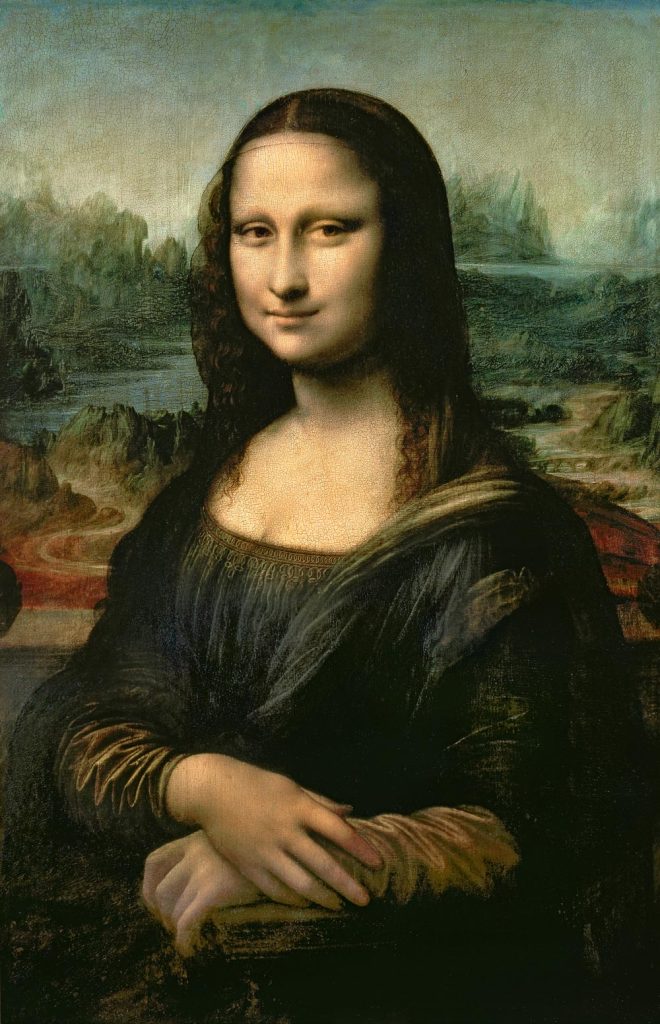
Leonardo Da Vinci, Mona Lisa
(The Gioconda), 1503–18
The portrait of Lisa del Giocondo (1479–1542) was commissioned from Leonardo in Florence by her husband Francesco (1460–1539), a silk merchant. The artist began the painting in 1503 before taking it with him, unfinished, to Milan and then to France, where it was purchased by Francis I, possibly in 1518.
Leonardo used a poplarwood panel, a usual choice in Tuscany, for a work that portrays a woman, life size, seated in a tub chair, her hands crossed over her belly, in front of a balustrade behind which we spy a sweeping panorama with mountain chains, roads and a river crossed by a bridge. Scholars have identified the landscape variously with certain areas in the provinces of Pisa and Arezzo.
Yan Pei-Ming recalls: “I didn’t want to produce the portrait from a painting. For me Mona Lisa is a model, she isn’t a painting but a woman who posed for Leonardo and who is now posing for me. Hence my realistic treatment of her face and hands (…). I said to myself that she was too beautiful, that I couldn’t maltreat her.” “I wanted to give her another life, and so the most effective way to do that was to bury her.” “Bury the myth” that inspired Duchamp, Warhol, Botero and Banksy, among others, “in order to breathe new life into the act of painting.” So he has prolonged the icon with two broad landscapes at the sides and added the portrait of his dying father and an imaginary portrait of himself dead to the side panels. With this personal addition to one of the world’s most iconic artworks, Yan Pei-Ming also addresses the father-son relationship, one of the primordial archetypes.
Room 4: Art Histories
Jean-Paul Marat
Boudry, 24 May 1743 – Paris, 13 July 1793
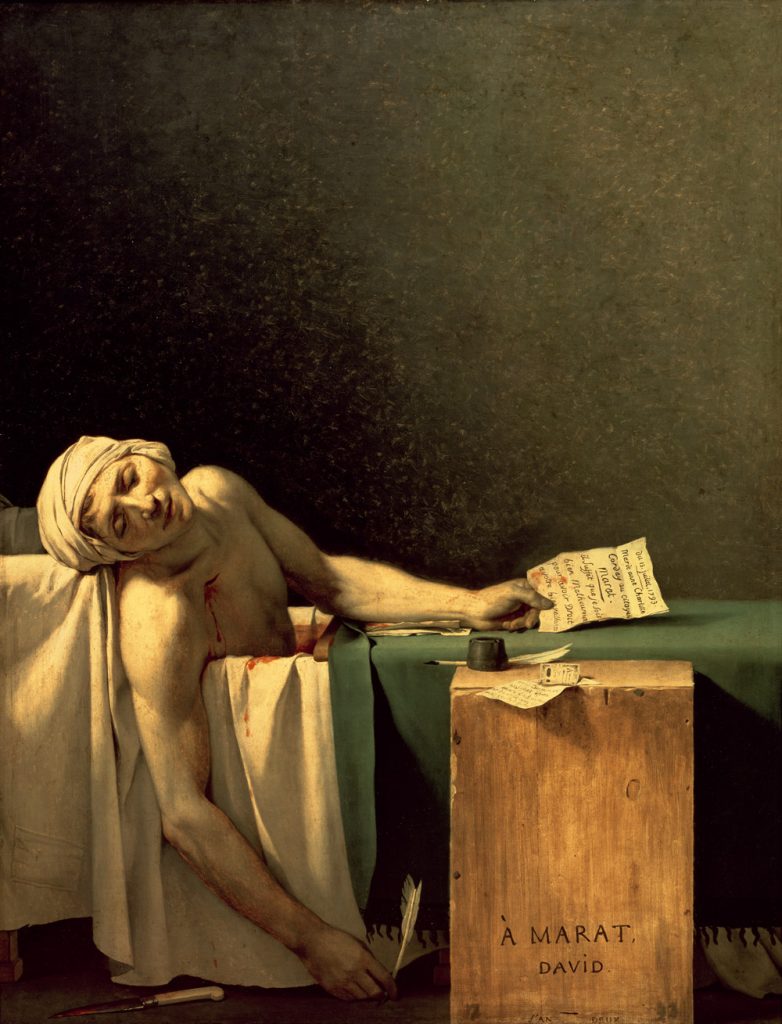
A Swiss-born journalist, doctor of medicine and politician who moved to Paris, Marat was the Editor-in-Chief of L’Ami du peuple, founded in 1789: he himself was later to be known by that same monicker. One of the leading players in the French Revolution and a fervent opponent of the monarchy, elected to the National Convention and appointed President of the Club des Jacobins in April 1793, he was one of those responsible for the Girondin massacres and the start of what became known as the Reign of Terror. He was stabbed to death by a Girondin supporter named Charlotte Corday while he was in his bath tub attempting to alleviate the symptoms of a skin ailment.
Yan Pei-Ming has drawn his inspiration from Jacques-Louis David’s painting Marat assassiné (The Death of Marat), now in the Musée Royaux de Beaux-Arts in Brussels. David, a friend of Marat, was tasked with capturing the scene and organising the public display of the body, which was presented in the nude to show the wound, “covered by a wet sheet supposed to represent the bath tub and which was hosed down every now and then to stem the putrefaction.” In the picture – painted at a later date and given by David to the Convention on 14 November 1793 – the scene is reconstructed to resemble a “pietà” or a “republican deposition” in an effort to transform Marat into a martyr of the Revolution with the wound in his side oozing blood and his arm hanging down in a position that echoes the work of both Michelangelo (the Vatican Pietà) and Raphael (the Borghese Gallery Deposizione).
While Baudelaire, writing in 1846, highlighted the chilly quality of David’s painting (“There is something at once both tender and poignant about this work; in the icy air of that room, on those chilly walls, about that cold and funereal bath tub, hovers a soul”), Yan Pei-Ming, on the contrary, makes it vibrate, revisiting it in three different dominants and placing the dramatic blood red version in the centre of his triptych.
Giovanni Battista Pamphili,
Pope Innocent X
Rome, 6 May 1574 – 7 January 1655
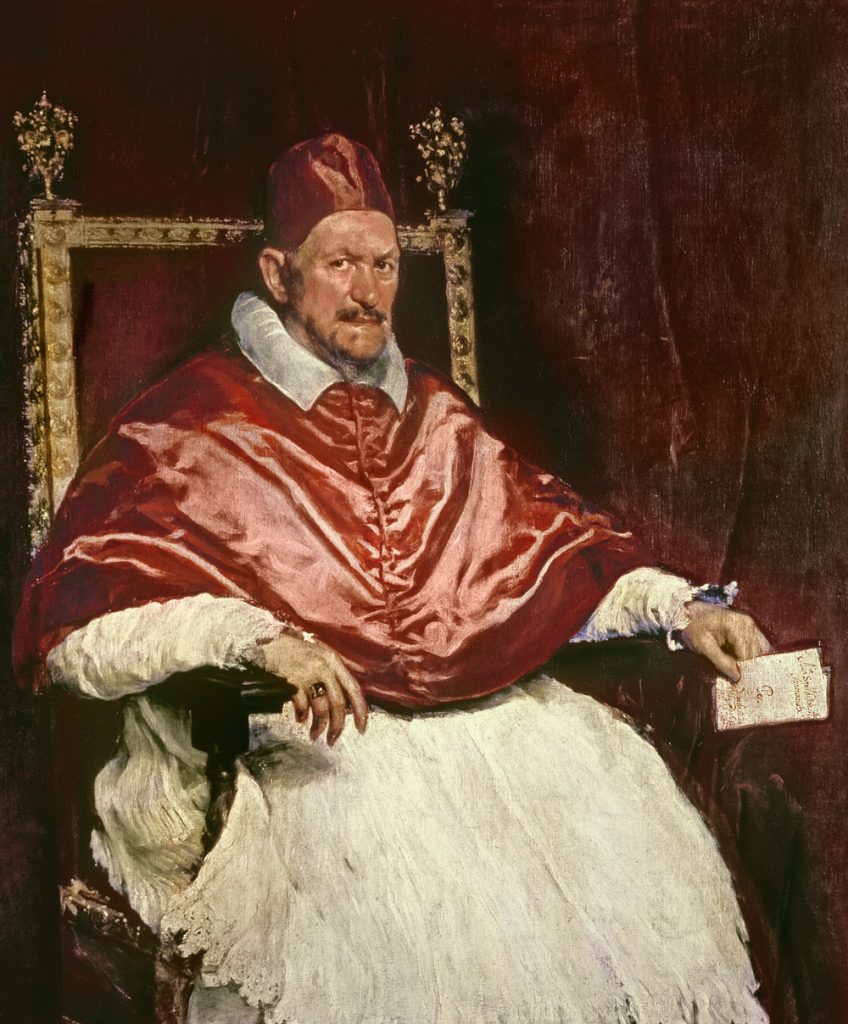
Innocent X, born Giovanni Battista Pamphili, was Pope from 1644 to 1655. Known for his nepotism, he was responsible for numerous major town planning projects in Rome, including the renovation of Piazza Navona with Gian Lorenzo Bernini’s Fountain of the Four Rivers, the family palazzo designed by Girolamo Rainaldi, on which Francesco Borromini also collaborated, and the church of Sant’Agnese in Agone. His many surviving portraits include two marble busts carved by Gian Lorenzo Bernini (in the Galleria Doria Pamphili), a bronze statue by Alessandro Algardi (in the Musei Capitolini) and a portrait painted by Diego Velázquez in Holy Year 1650.
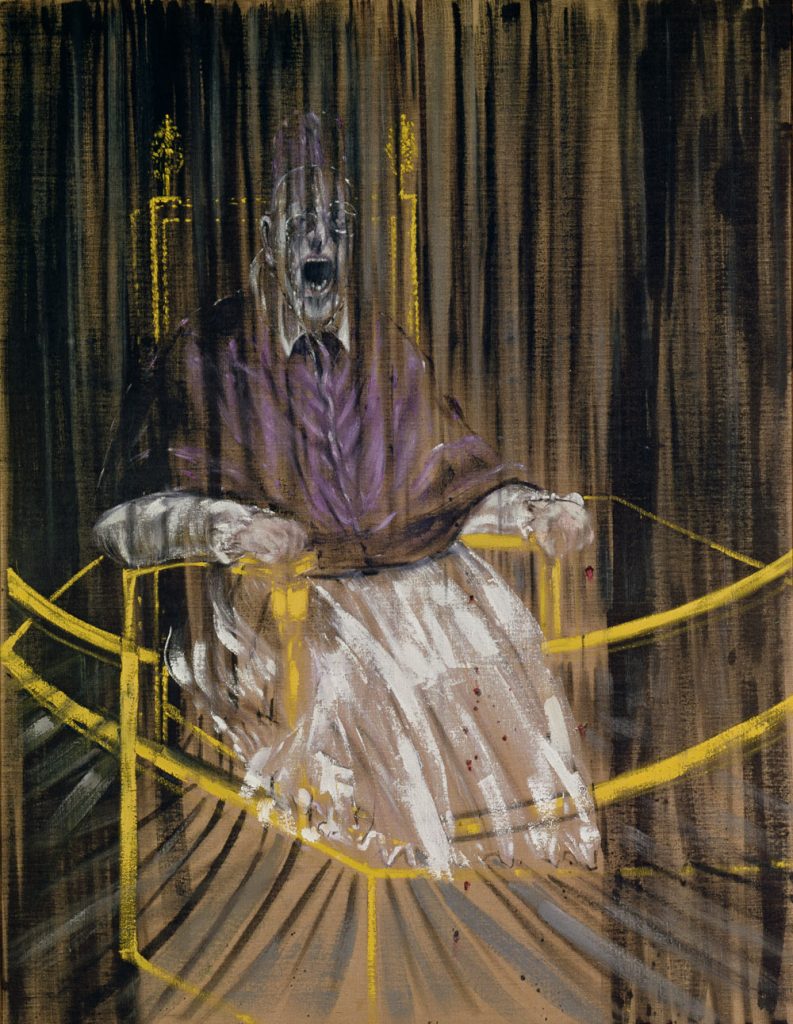
Yan Pei-Ming has taken his inspiration from the Velázquez portrait, veering away the Spanish artist’s dominant shades of red towards a blue marked by very dark streaks. He has maintained the Pope’s intense gaze but has transformed his hands: the left hand no longer rests listlessly on the arm of the chair but sports a closed fist in a gesture of power and determination, while the right hand no longer clutches a paper with the names of the painter and his sitter on it but is transformed into a claw. Yan Pei-Ming recalls how this 17th century portrait also inspired Francis Bacon: “I was fascinated when I discovered the portraits of Innocent X. The colour is fantastic. I was very inspired and I wanted, like Bacon, to work d’après Velázquez.”
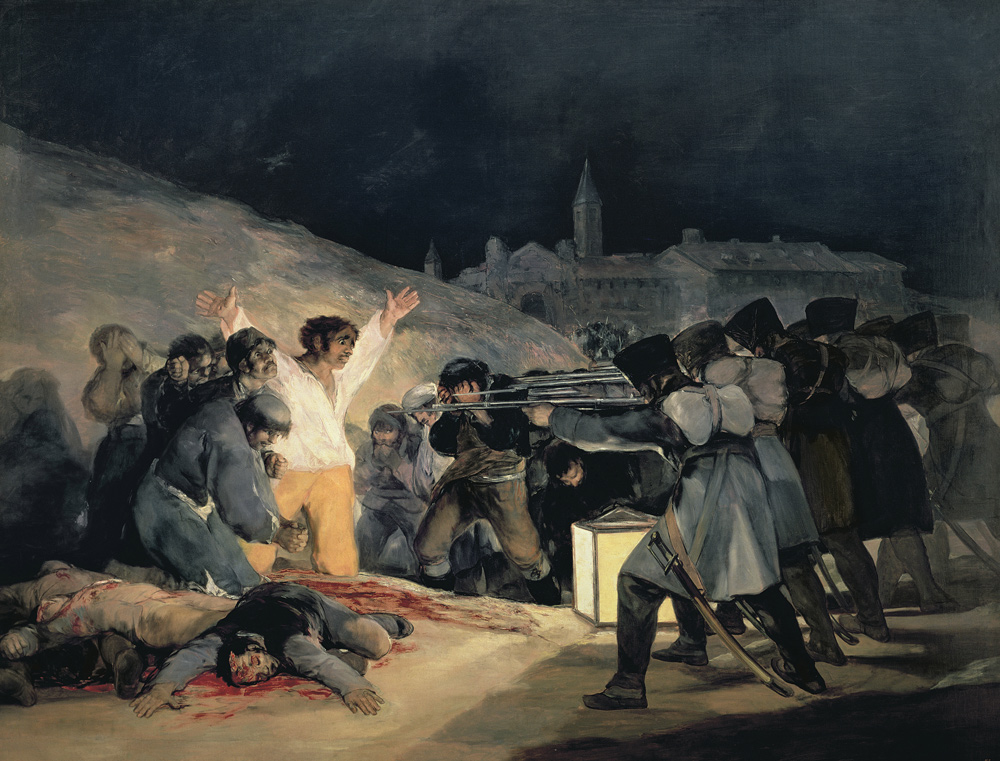
Francisco Goya, The Third Of May 18 Or Los Fusilamientos Del Tres De Mayo, 1814
At dawn on 3 May 1808, Napoleon’s troops which had invaded Spain executed dozens of rebels in various areas of Madrid in retaliation for their attempt to oppose the French on the previous day. Despite King Charles IV de Borbón having abdicated in favour of his son Ferdinand VII in March of that year, both men had had to give up the throne, which was given to Joseph-Napoléon Bonaparte. However, Napoleon’s weakness after his disastrous Russian campaign and England’s provision of aid subsequently allowed the Spanish guerrilla fighters to win a victory, and Ferdinand was able to return to the throne in May 1814.
Francisco Goya was commissioned to paint his large painting by the Regency Council, although it was not displayed in the Prado until 1872. The crudely realistic scene is dominated by the highlights on the figure of a peasant in a white shirt and the lantern illuminating the figures of the prisoners, shown in various different attitudes in order to convey feelings at times contrasting, while the French are shown only from behind. The painting, like others by Goya, aims to communicate the inhumanity of war.
Yan Pei-Ming, who painted his Exécution, après Goya in 2008, two hundred years after the massacre, explained: “I like tragic subjects because I find them eternal. Empathy is a way for me to express myself in painting. The subjects I choose stir an immense feeling in me, like Goya’s Tres de mayo. I ask myself: how can one man shoot another man?”
Napoleon Bonaparte
Ajaccio, 15 August 1769 – Island of St. Helena, 5 May 1821
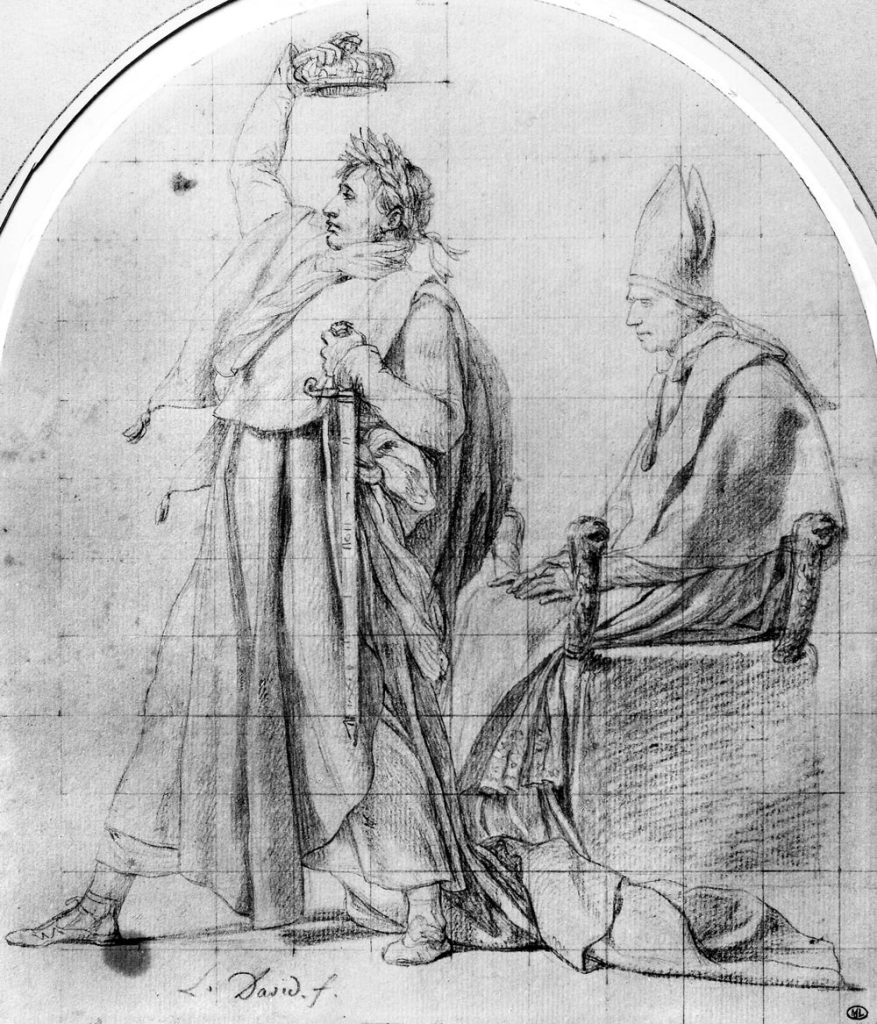
Born into a family of Italian origin, Napoleon studied in France. A General during the French Revolution, after his first Italian campaign he seized power in a coup in 1799 and became First Consul in 1804. With a view to his proclamation as Emperor of the French under the name of Napoleon I, Pope Pius VII travelled to Paris to attend the solemn ceremony, which took place on 2 December 1804. Napoleon held onto the title until April 1814, when he abdicated after a series of disastrous military campaigns, first and foremost the campaign in Russia. Exiled to Elba, he fled, returned to Paris and to power for his “One hundred days” until 22 June 1815 when his defeat at Waterloo brought his career to a close. He spent his final years in exile on the island of St. Helena, which was under British rule at the time, in the south-central Atlantic Ocean.
Yan Pei-Ming has revisited Jacques-Louis David’s preparatory cartoon for the large painting entitled Le Sacre de Napoléon (The Coronation of Napoleon, 1805–7, Paris, Musée du Louvre) in which both the Emperor and the Pope are portrayed, but Ming excludes the Pope, focusing on the novel gesture of Napoleon’s self-coronation. New rituals were introduced in the course of the ceremony, with which Napoleon sought to emphasise the fact that he was being crowned Emperor for his own merits and the will of his people rather than by religious consecration. Yan Pei-Ming’s interest, as he tells us, is in “the story of men of power” emblematically embodied, in this instance, by Bonaparte.
Rooms: Time
Vladimir Putin
Leningrad, 7 October 1952
After graduating in law in Leningrad, Vladimir Putin joined the KGB, working in the German Democratic Republic (DDR) from 1985 to 1989. Returning to Russia, he took a stance in favour of perestroika and left the KGB in 1991. Moving to Moscow in 1996, he became a close aide of Boris Yeltsin, whom he succeeded as head of state, initially in an acting capacity but subsequently confirmed by election in 2000. He has been re-elected, either as President or as Prime Minister, in every subsequent election since then. The approval of a referendum in 2020 eliminated the constraint on a second consecutive presidential mandate. In February 2020 he imparted a fresh boost to Russia’s imperialist plan by annexing Crimea, invading Ukraine and recognising the independence of the self-proclaimed People’s Republics of Donetsk and Luhansk in the Donbas region. In March 2023, the International Criminal Court in The Hague issued an arrest warrant for him on a charge of committing war crimes against Ukrainian children. In the course of his first mandate as President, the Russian economy grew considerably for eight years in a row, but democracy in Russia also suffered a gradual reversal of fortune.
Putin appeared as “man of the year” on the cover of the last edition of Time magazine in 2007, at the end of his first presidential mandate, with the following motivation: “If Russia fails, all bets are cancelled for the 21st century. And if Russia is successful as a nation state in the family of nations, it will owe a large part of that success to one man, Vladimir Vladimirovich Putin.” Yan Pei-Ming recalls “The triptych entitled Vladimir Putin, Tsar of The New Russia (2008) was produced when I saw a cover of Time magazine for 2007. I instantly reacted: This is my subject, consistent with my interest in ‘the story of men of power’.”
Volodymyr Zelensky
Kryvyj Rij, 25 January 1978
A politician, actor, film director, comedian and scriptwriter, Volodymyr Zelensky graduated in jurisprudence in Kyiv before going on to found a production company called Kvartal 95, producing films, cartoons and, in 2015, the TV series Servant of the People in which Zelensky himself plays a teacher who is almost accidentally elected President of Ukraine. Following its success and the foundation of a party named after the series, Zelensky stood for election on 31 December 2018 and became President of Ukraine in April 2019. Since the Russian Army invasion in February 2022, he has become the symbol of Ukrainian resistance. Time magazine explained its choice of Zelensky, and the “spirit of Ukraine,” as person of the year 2022 thus: “Whether the battle for Ukraine fills one with hope or with fear, Volodymyr Zelensky galvanized the world in a way we haven’t seen in decades. In the weeks after Russian bombs began falling on February 24, his decision not to flee Kyiv but to stay and rally support was fateful. From his first forty-second Instagram post on February 25 – showing that his Cabinet and civil society were intact and in place – to daily speeches delivered remotely to the likes of houses of Parliament, the World Bank, and the Grammy Awards, Ukraine’s President was everywhere. His information offensive shifted the geopolitical weather system, setting off a wave of action that swept the globe.”
Referring also to the triptych depicting Putin, Yan Pei-Ming recalled: “When I saw Zelensky on the cover of Time magazine in 2022, I realised how the two works would clash. The art of painting is already a commitment. I make a statement, I express myself in the picture, I show it to the public and then it is up to them to react. I weep over our times and at the same time I am happy to live in this world. We are all passing through, while the earth will keep going round.”
Room 5: Paper Tiger
Bruce Lee
San Francisco, 1940 – Hong Kong, 20 July 1973
An actor, director and the most famous martial arts expert, Bruce Lee was born in San Francisco’s Chinatown in the year of the Dragon during a tour of the Cantonese company of which his father was a member. The name Lee Jun Fan, which means “come back again Lee”, shows that his parents hoped he would soon return to the United States, but he lived for many years in Hong Kong where he learnt various styles of Kung-Fu and began to work in the film industry. Moving to the United States where he adopted the stage name Bruce Lee, he studied “drama/philosophy” at the University of Seattle and taught martial arts there before transferring to Los Angeles in 1966. He started to work in TV series but returned to Hong Kong where he achieved stardom with a number of films, including Fist of Fury (1972).
Yan Pei-Ming’s iconographic source is a still from the film Enter the Dragon, the fourth film in which Bruce Lee played the starring role. The film, designed for the Western market, was his greatest international success and also the last film he ever played in before his sudden death. Ming said that one of the reasons he painted the Kung-fu master – a perfect link between East and West – was that Warhol had not done so, perhaps because “he wasn’t upmarket enough.”
Mao Zedong
Shaostan, 26 December 1893 – Beijing, 9 September 1976
A revolutionary, politician, philosopher, poet, Chairman of the Chinese Communist Party from 1945 until his death and President of the People’s Republic of China from 1949 to 1959, Mao Zedong was responsible for, among other things, developing Marxist-Leninist thought in a Chinese vein – “Maoism” – and launching the proletarian Cultural Revolution in 1966. The object of a widespread personality cult which also made use of images, he was known as “Chairman Mao” or “The Great Helmsman.”
Yan Pei-Ming grew up with the figure of Mao: “On my first day at school, as indeed in the rest of China during the Cultural Revolution, our first lesson was a good morning with ‘Long live Chairman Mao’. Everyone had to do it.” Portraits of Mao – with which Ming began to make a name for himself in the West – form the common thread of his painting: “Every time I do a portrait of Mao there’s a problem. For me it’s a kind of word or energy. It’s also a kind of fetish and it’s like a pause or a focal point.” He added: “I was interested in mankind, not in individuality. To give a meaning to all of these anonymous people I painted just one recognisable man: Mao”, whom he calls “the maître à penser of all my generation, a man at once brilliant, cruel, a strategist and cultivated.”
The image that Yan Pei-Ming has chosen for this picture shows the Great Helmsman looking earnest, clapping (one of the frequent attitudes that he adopted in his official portraits), painted in red and white, while in his early works Ming painted him in black and white.
Room 6: Italian Stories
Pier Paolo Pasolini
Bologna, 5 March 1922 – Idroscalo di Ostia, night of 1/2 November 1975
One of the 20th century’s greatest thinkers, Pier Paolo Pasolini was a poet, writer, scriptwriter, film and theatre director, journalist, essayist and literary critic tirelessly committed to testifying and to defending his sexual preference. He wrote numerous collections of poems in Friulano dialect, while Ragazzi di vita (1955) and Una vita violenta (1959) rank among his best-known and most controversial novels, and his articles for “Corriere della Sera” (from 1973) have been collated in the celebrated Scritti corsari. After working as a scriptwriter, he directed such milestones in cinema history as Accattone (1961), Mamma Roma (1962), La ricotta (an episode in a collective film entitled Ro.Go.Pa.G, 1963), Il Vangelo secondo Matteo (1964), Uccellacci e uccellini (1966), Edipo re (1967) and I racconti di Canterbury (1972); Salò o le 120 giornate di Sodoma was released after his death. He was barbarously murdered on the night of 1/2 November 1975.
The photograph of the scene showing the discovery of Pasolini’s body, from which Yan Pei-Ming has drawn his inspiration, is one of the many taken in the rundown area of the Idroscalo in Ostia where he was found. A Carabinieri officer and men from the Rome Flying Squad and Homicide Squad squat next to his battered body. In the painting, the scene focuses on the lower part of the photograph, eliminating the shacks in the background, while the number of standing onlookers has been cut to four and their faces and busts have been erased.
During his time in Rome, Yan Pei-Ming felt a deep admiration for Mamma Roma and Il Vangelo secondo Matteo, drawing his inspiration for the paintings from them. About the second painting, on display in the exhibition, he said: “The film is stunning. The presence of the Crucifixion and the scene of the discovery of Pasolini’s body in the same room creates a visual tension in the exhibition. I wanted to pay tribute to the greatness of this outstanding man and personality.”
Aldo Moro
Maglie, 23 September 1916 – Rome, 9 May 1978
A politician and jurist, Moro was one of the founder members of the Christian Democratic Party (DC), its Secretary from 1959 to 1964 and the creator of the “Morotea” faction which centred around him. A cabinet minister (of Justice, of Education and of Foreign Affairs) in several governments and himself five times President of the Council of Ministers, he was one of the promoters of the “historic compromise” involving overtures to the Communist Party (PCI), which resorted to abstention to back the third and fourth Andreotti governments. Moro was abducted by the Red Brigades in Via Fani, in Rome, on 16 March 1978, in the course of an ambush in which five members of his bodyguard were killed. He was kept hidden in what the terrorists called a “people’s prison” for fifty-five days, in the course of which the political parties debated whether or not it would be appropriate to negotiate with the terrorists. His body, riddled with bullets, was found in the boot of a red Renault 4 in Via delle Botteghe Oscure, one hundred and fifty metres from the PCI headquarters and two hundred metres from the headquarters of the DC.
Yan Pei-Ming has drawn his inspiration from a photograph taken by photojournalist Domenico De Carolis with his Nikon Reflex from the window of a nearby building at around 2.30 pm on 9 May. De Carolis recalled that when the boot was opened and the blanket concealing the body moved aside: “We saw him, in the position everyone knows. And at that moment our eyes on Moro became part of that story.”
Room 8: The night
Benito Mussolini
Dovia di Predappio, 29 July 1883 – Giulino di Mezzegra, Dongo, 28 April 1945
Benito Mussolini was a politician, a journalist, the founder of Fascism, President of the Council of the Kingdom of Italy from 31 October 1922 to 25 July 1943 and, from 1925, leader of the government, Prime Minister, Secretary of State and First Marshal of the Empire after the war in Ethiopia in 1938. Drawing close to Hitler’s Germany, he signed the Pact of Steel in 1939 and promulgated the race laws. He decided that Italy would join World War II in June 1940. Losing a confidence motion in the Great Council of Fascism on 24 July 1943, he was arrested. Freed by the Germans, he set up the Italian Social Republic, leading it from September 1943 to April 1945. He left Milan on 25 April to try to reach Switzerland, but he was captured by partisans at Dongo on Lake Como and shot, together with his mistress Claretta Petacci, by order of the National Liberation Committee on 28 April. On 29 April the bodies of Mussolini, Claretta Petacci and three Fascist hierarchs were hung upside down from the beams of the Esso petrol station canopy in Piazzale Loreto, where the Fascists had executed 15 partisans in 1944.
Yan Pei-Ming has drawn his inspiration from the photograph – taken, along with many others, probably by Fedele Toscani for the Publifoto agency founded by Vincenzo Carrese – in which the frame is restricted to Mussolini and Claretta. The artist focuses on the figures, highlighting such details as the belt around the woman’s skirt and the man’s missing boot.
The image of Mussolini conjures up a sensation of barbarity, which has a long and terrifying tr