Fra Angelico
from 26 September 2025
to 25 January 2026
- Museo di San Marco
- Palazzo Strozzi
- Piano nobile
- Daily 10.00-20.00Thursdays until 23.00
- Ticket required
- Amici di Palazzo Strozzi: free
From September 26, 2025, to January 25, 2026, the Fondazione Palazzo Strozzi and the Museo di San Marco present Fra Angelico, an extraordinary and unprecedented exhibition devoted to an artist who symbolises fifteenth-century Florentine art and stands out as one of the greatest masters of Italian art of all time.
The exhibition, organized in collaboration between the Fondazione Palazzo Strozzi, the Ministero della Cultura – Direzione regionale Musei nazionali Toscana and Museo di San Marco in a close dialogue between cultural institutions and the region, is one of the leading cultural events of 2025. It celebrates a father of the Renaissance in two venues: the Palazzo Strozzi and the Museo di San Marco.
The exhibition explores Fra Angelico’s art, development and influence and his relation to painters such as Lorenzo Monaco, Masaccio, and Filippo Lippi, as well as sculptors like Lorenzo Ghiberti, Michelozzo, and Luca della Robbia. Curated by Carl Brandon Strehlke, Curator Emeritus of the Philadelphia Museum of Art, with – for the Museo di San Marco – Angelo Tartuferi, former Director of the Museo di San Marco, and Stefano Casciu, Regional Director of Musei nazionali Toscana, Fra Angelico marks the first major exhibition in Florence dedicated to the artist exactly seventy years after the monographic show of 1955, creating a unique dialogue between institutions and the region.
Renowned for a style that evolved from a late Gothic legacy while embracing the principles of the emerging Renaissance, Fra Angelico (Guido di Piero, Fra Giovanni da Fiesole; Vicchio di Mugello c. 1395– Rome 1455) created paintings celebrated for their mastery of perspective and light, shaping an unprecedented and innovative relationship between figures and space. The exhibition offers a unique opportunity to explore extraordinary artistic vision of this friar painter deeply rooted in religious devotion, centred on a reflection of the sacred in relation to the human.
The exhibition brings together more than 140 works of art across the two venues that include paintings, drawings, sculptures, and illuminated manuscripts from leading institutions such as the Louvre in Paris, the Gemäldegalerie in Berlin, the Metropolitan Museum of Art in New York, the National Gallery of Art in Washington, D.C., the Vatican Museums, the Alte Pinakothek in Munich, the Rijksmuseum in Amsterdam, and numerous libraries, churches, and collections both in Italy and internationally.
The result of over four years of preparation, the project has enabled an undertaking of exceptional scholarly and cultural importance, thanks also to an extensive campaign of restorations and the singular opportunity to reunite altarpieces that were disassembled and dispersed over two hundred years ago.
Exhibition walkthrough
Fra Angelico offers a journey between Palazzo Strozzi and the Museo di San Marco, with over 140 works including paintings, drawings, sculptures and illuminated manuscripts from leading Italian and international museums and collections. The itinerary weaves together biography, contexts of patronage and dialogues with other artists, restoring Fra Angelico’s role as a key figure in the birth of the Florentine Renaissance.
At Palazzo Strozzi, the visit unfolds in eight sections organised in a chronological and thematic sequence that retraces the artist’s entire career. From the Florence of Santa Trinita emerges the role of major patrician families in renewing early fifteenth‑century visual culture, poised between the narrative taste of the International Gothic and the first responses to the new Renaissance art. The following sections chart the development of Angelico’s new language in the city’s religious settings, his decisive relationship with the convent of San Marco, the success of shaped Crucifixions and the spread of intense “holy faces” destined for private devotion. Sections devoted to large altarpieces for public and family patrons, to his Roman sojourns and to his ties with the Medici family highlight the breadth of his activity, culminating in a multimedia focus that gathers visitors’ images in a participatory social wall.
At the Museo di San Marco, the itinerary focuses on Angelico’s beginnings and on his dialogue with Florentine figurative culture, starting from the Fiesole Altarpiece and the monumental Tabernacle of the Linen‑workers. The historic spaces of the convent – from the Cloister of Sant’Antonino to the Chapter House, from the dormitory with its frescoed cells to the Library – allow visitors to enter the very places for which the artist worked, among major fresco cycles and panel paintings, in close connection with Dominican spirituality. A special section in the Library is devoted to Angelico as an illuminator and to the outstanding group of humanist manuscripts once preserved here and now reunited for the exhibition, offering a privileged insight into the role of books and written culture in shaping the artist’s imagination.
Fra Angelico
Vicchio di Mugello, 1395 – Roma, 1455
Fra Angelico, born Guido di Piero in the Mugello area around 1395, was a Dominican friar, painter and illuminator and one of the key protagonists of the early Florentine Renaissance. Celebrated by his contemporaries as an example of holiness and artistic talent, he was officially recognised in the twentieth century when Pope John Paul II proclaimed him Blessed (1982) and patron of artists (1984).
Trained in Florence in contact with Lorenzo Ghiberti, Lorenzo Monaco and the cultured milieu of Santa Maria degli Angeli, Angelico entered the community of the Observant Dominicans, taking the name Fra Giovanni and linking his artistic practice from the outset to religious life. Between Fiesole and Florence he produced altarpieces and frescoes for convents, confraternities and leading families, establishing himself as a master capable of combining devotion, late Gothic refinement and new Renaissance principles of space and light.
His privileged relationship with Cosimo de’ Medici and Saint Antoninus Pierozzi led him to work for the convent of San Marco, where he frescoed the cells, corridors and Chapter House, creating an extraordinary figurative programme designed to nourish the friars’ meditation. At the same time, his activity as an illuminator renewed the art of the decorated manuscript, in dialogue with the humanist culture that revolved around Niccolò Niccoli’s library and the codices preserved at San Marco.
From the 1440s onwards Angelico’s career expanded beyond Florence: he worked in Cortona and Perugia, then in Rome and Orvieto, where he was called by Popes Eugenius IV and Nicholas V to decorate chapels in the Vatican and in St Peter’s Basilica, culminating in the masterpiece of the Niccoline Chapel. In these cycles he broadened his language, orchestrating solemn narratives within grand architectural settings inspired by antiquity and by new theories of perspective, in close harmony with contemporary humanist thought.
Fra Angelico died in Rome in 1455 and was buried in the Dominican church of Santa Maria sopra Minerva, where his epitaph remembers him as a “second Apelles” and praises him more for his charity than for his skill as a painter. The exhibition at Palazzo Strozzi and the Museo di San Marco follows the key stages of his life and spiritual journey, revealing an artist capable of translating the light of faith into painting of striking and enduring modernity.
Fra Angelico is promoted and organized by Fondazione Palazzo Strozzi, Ministero della Cultura – Direzione regionale Musei nazionali Toscana and the Museo di San Marco.
Fondazione Palazzo Strozzi Public Supporters: Comune di Firenze, Regione Toscana, Città Metropolitana di Firenze, Camera di Commercio di Firenze.
Fondazione Palazzo Strozzi Private Supporters: Fondazione CR Firenze, Fondazione Hillary Merkus Recordati, Comitato dei Partner di Palazzo Strozzi.
Main Partner: Intesa Sanpaolo.
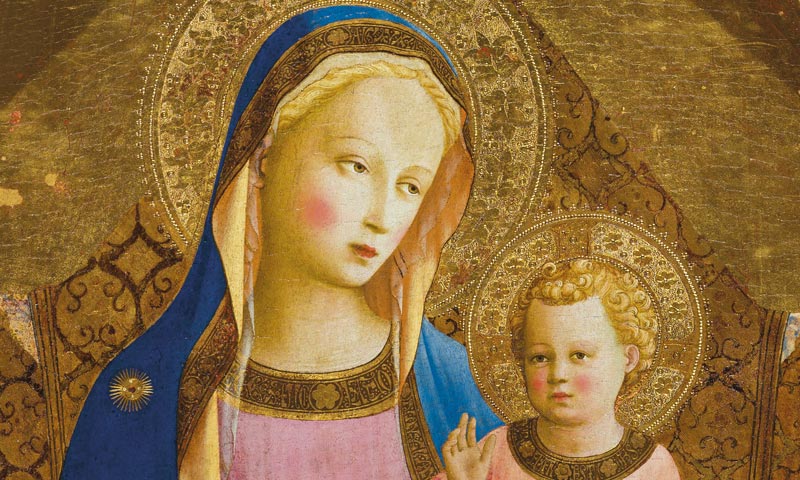
Cover: Fra Angelico, Trittico francescano (det.), 1428-1429. Su concessione del Ministero della Cultura – Direzione regionale Musei nazionali Toscana – Museo di San Marco