Anselm Kiefer
Fallen Angels
from 22 March 2024
to 21 July 2024
- Courtyard
- Piano nobile
- Daily 10.00-20.00Thursdays until 23.00
- Ticket required
- Amici di Palazzo Strozzi: free
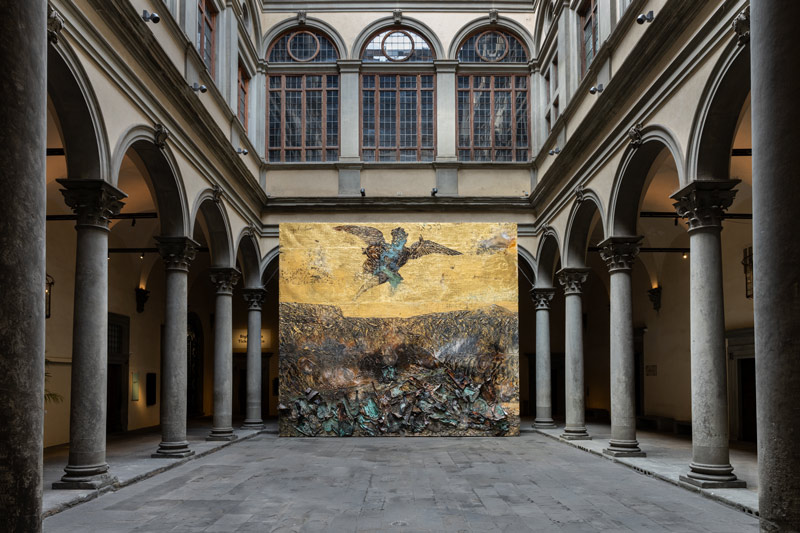
Palazzo Strozzi presents a major exhibition dedicated to one of the greatest masters of the 20th and 21st century art, Anselm Kiefer. The exhibition allows direct contact with the art of the German artist thorough new and historical works that engage in a profound dialogue with the Renaissance architecture of Palazzo Strozzi, including a new work especially created for the palace’s internal courtyard.
Curated by Arturo Galansino, General Director of the Fondazione Palazzo Strozzi, Anselm Kiefer. Fallen Angel is a journey that reflects on topics such as identity, history, and philosophy.
Through painting, sculpture, installation and photography, Kiefer’s art offers deep introspection into the human condition, in a complex weaving of connections between the past, present and future. Since his debut on the art scene in the late sixties, Anselm Kiefer is involved in an impactful, richly-layered work that explore themes of memory, myth, history, literature, and poetry. Every work of Kiefer expresses a refusal of limits—not only through scale and materiality—but also through the infinite richness of resources with which he probes the depths of memory and the past.
Fotogallery
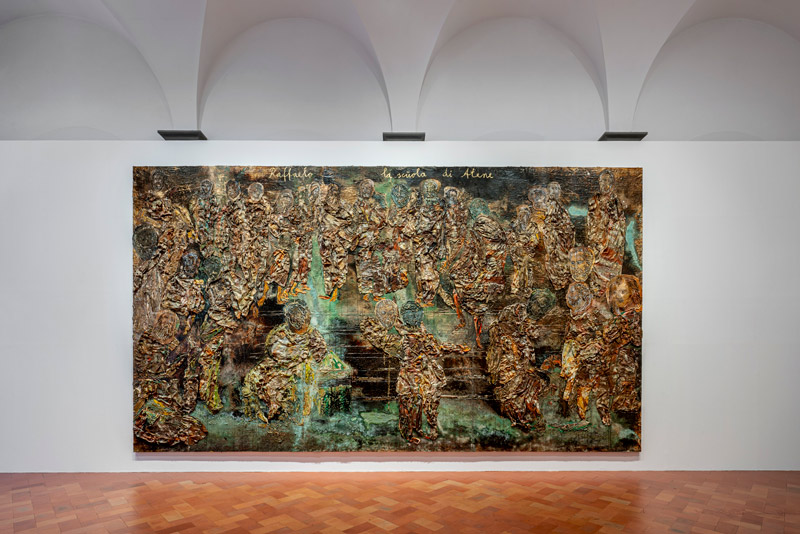
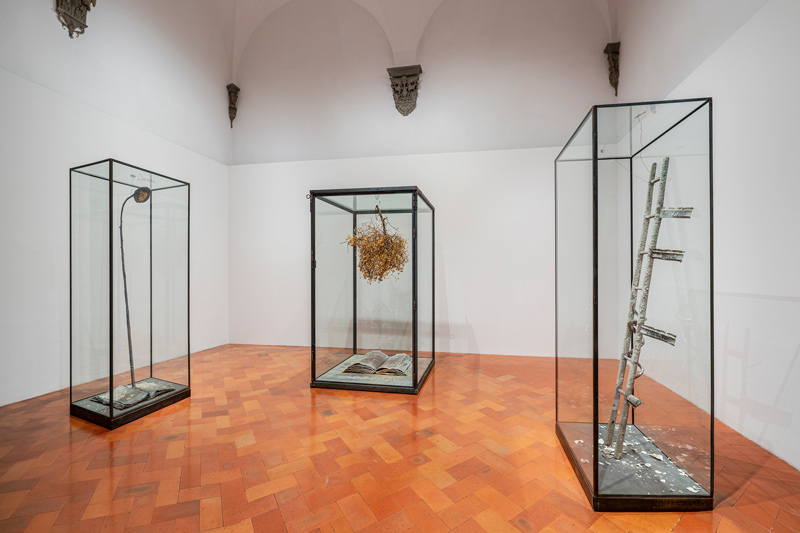
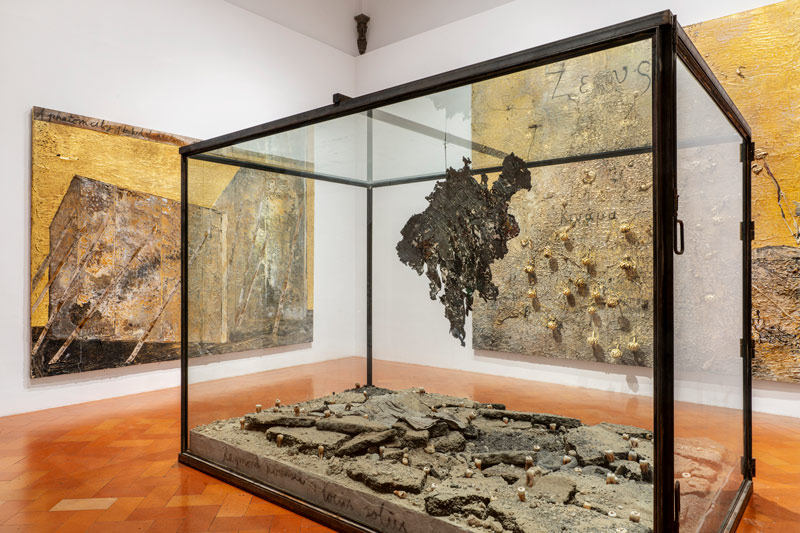
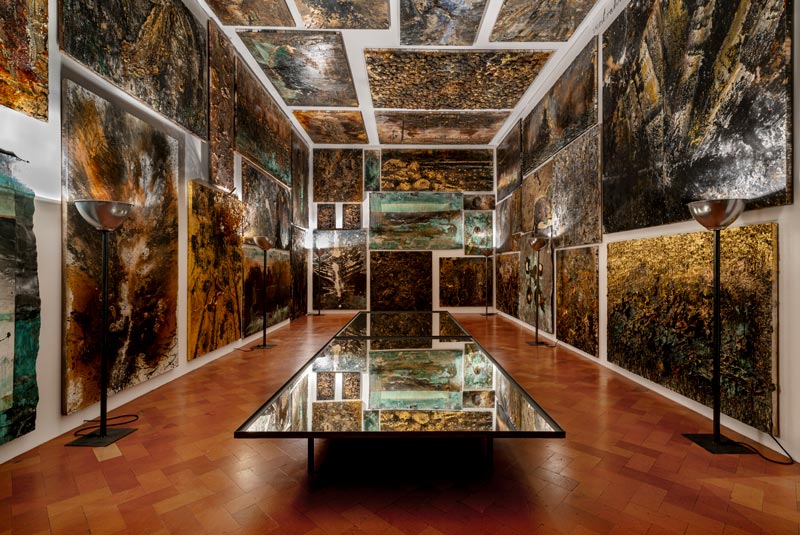
Exhibition walkthrough
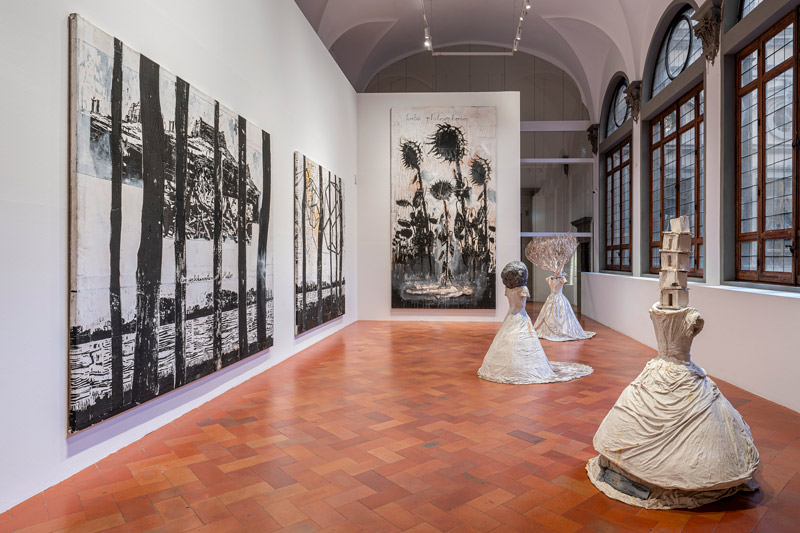
Anselm Kiefer. Fallen Angels stands as a major exhibition conceived by the artist in direct dialogue with Palazzo Strozzi’s spaces, spanning the Piano Nobile galleries and Renaissance courtyard. Through twenty-five historical and recent works—including an immersive installation of sixty canvases of varying sizes—it explores Kiefer’s diverse practice encompassing painting, sculpture, installation, and photography.
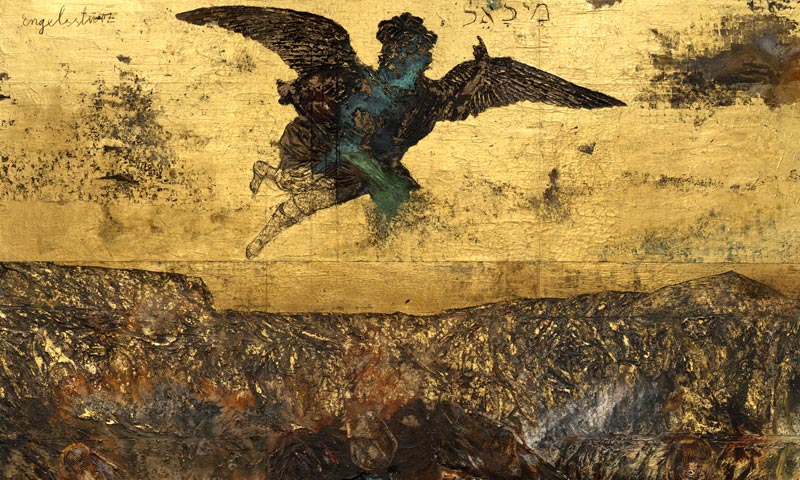
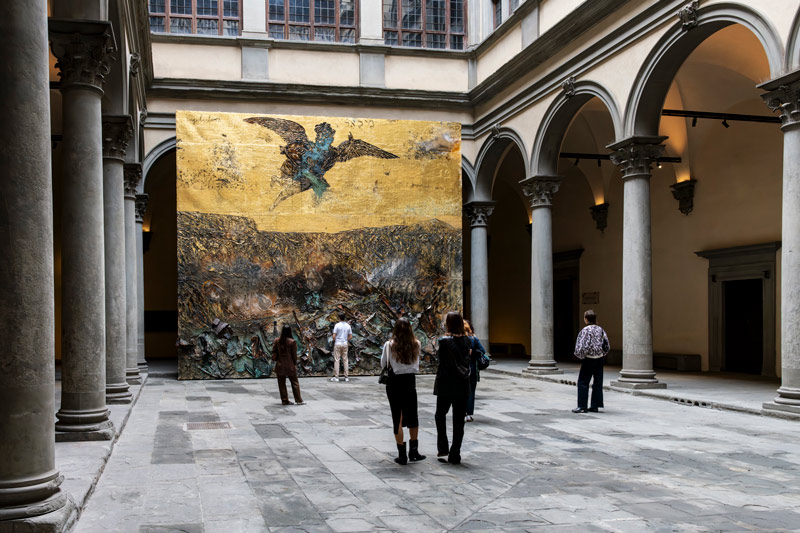
In the courtyard, Engelssturz (2022–2023), supported by the Hillary Merkus Recordati Foundation and exceeding seven meters in height, depicts the battle between the archangel Michael and rebel angels from the Book of Revelation—a metaphor for Good and Evil—inviting reflection on spirit and matter against the Renaissance architecture.
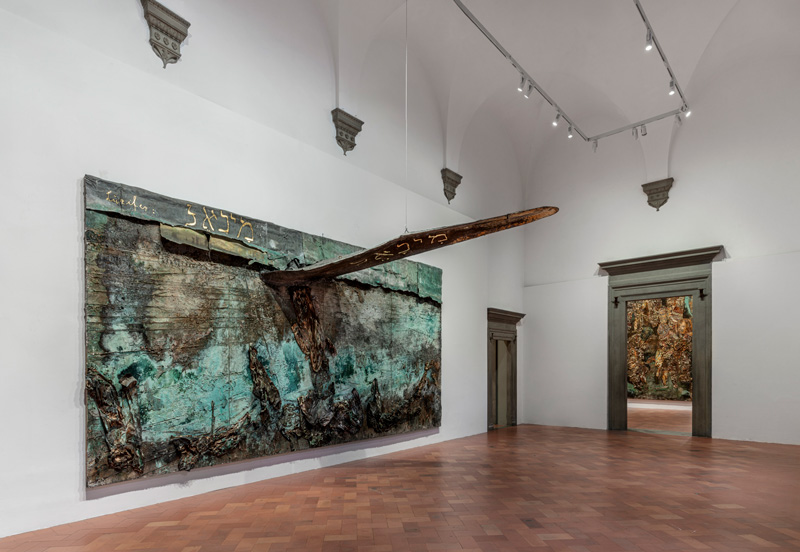
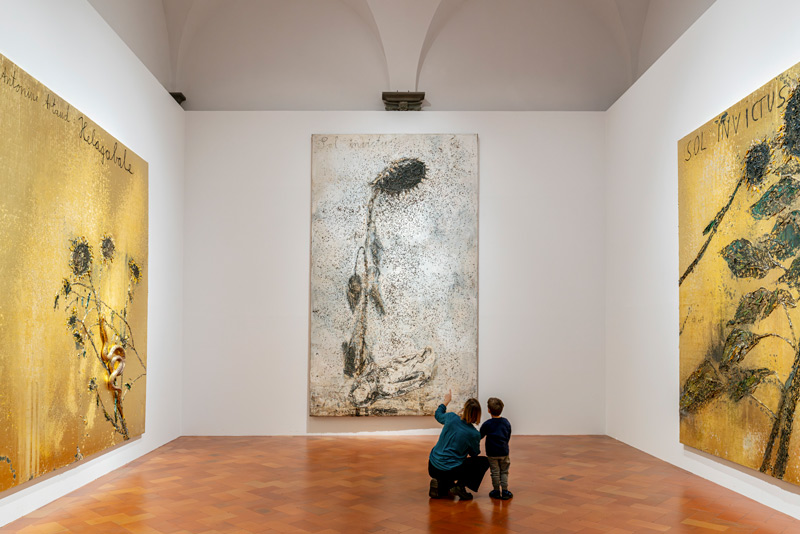
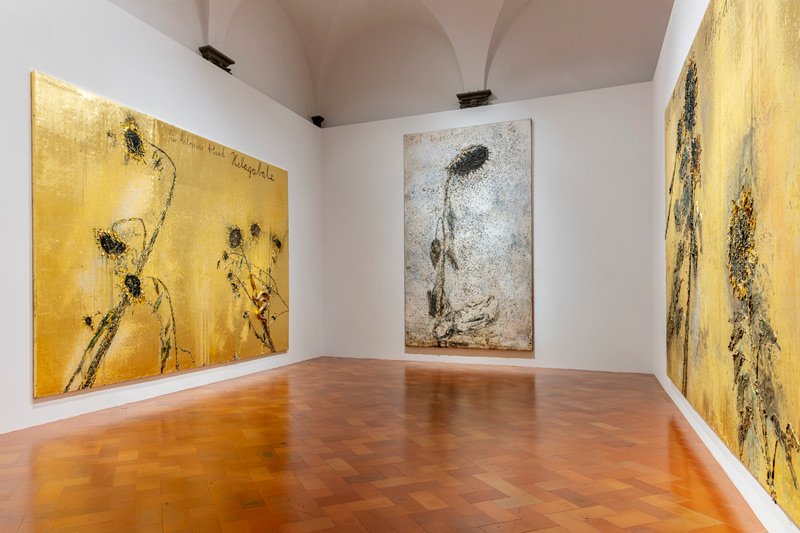
On the Piano Nobile, Luzifer (2012–2023) evokes the fallen angel with a menacing lead airplane wing protruding from chaotic matter, symbolizing war and human devastation. Für Antonin Artaud: Helagabale (2023) and Sol invictus Heliogabal (2023) reinterpret Emperor Heliogabalus, featuring recurrent Kieferian motifs like sunflowers and snakes as allegories of sun, earth, regeneration, and Van Gogh.
Philosophy section spotlights new works: La Scuola di Atene (2022), Vor Sokrates (2022), and Ave Maria (2022) trace philosophy’s shift from cosmology to ethics; Hortus Philosophorum (1997–2011) unites sunflowers, the human body, and Robert Fludd, symbolizing earth-sky union and initiatory path.
Vitrines like En Sof (2016) (kabbalistic), Das Balder-Lied (2018) (Scandinavian), Danae (mythological), and Locus solus (2019–2023) (Roussel) employ lead and glass for isolated microcosms, evoking alienation, alchemy, and literature (Joyce, mythology).
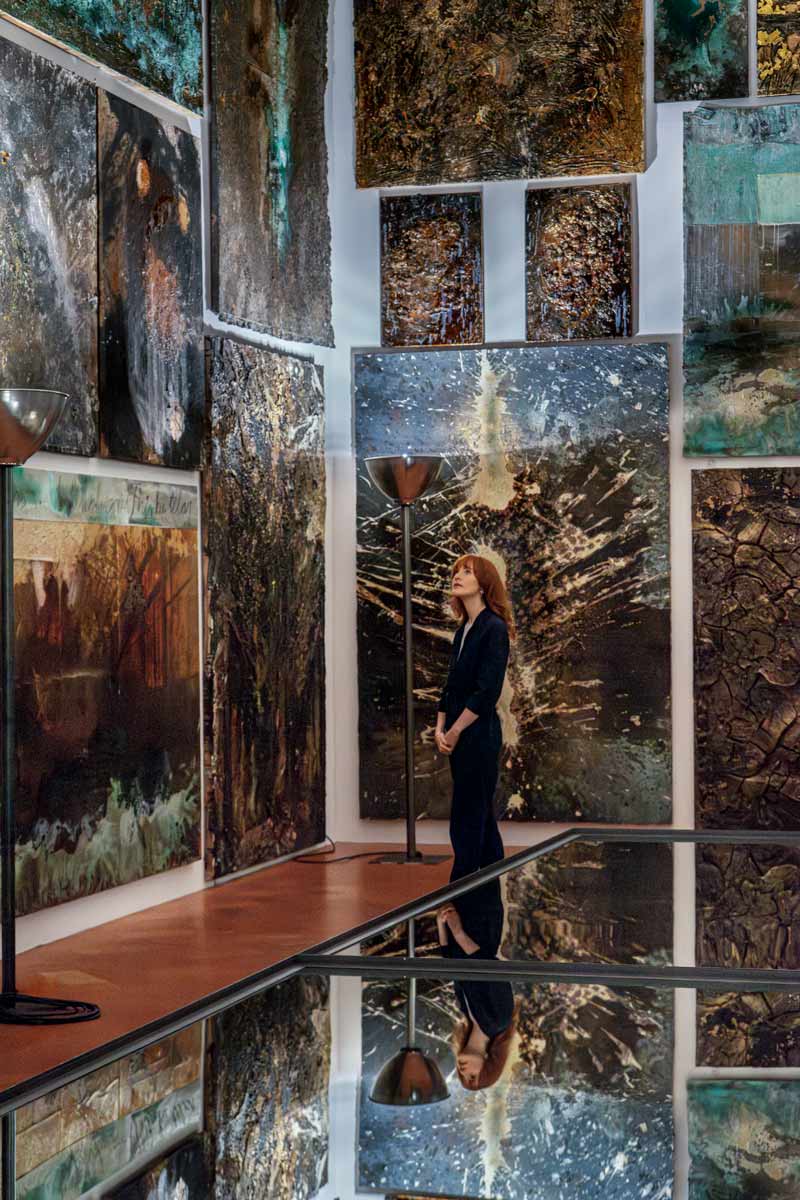
Immersive installation Verstrahlte Bilder (1983–2023) fills walls and ceiling with sixty scarred, radiation-faded canvases, plus central mirrors, immersing viewers in Kiefer’s stratified art—hauntingly exploring destruction, decay, and life’s fragility via oil, shellac, and fabric.
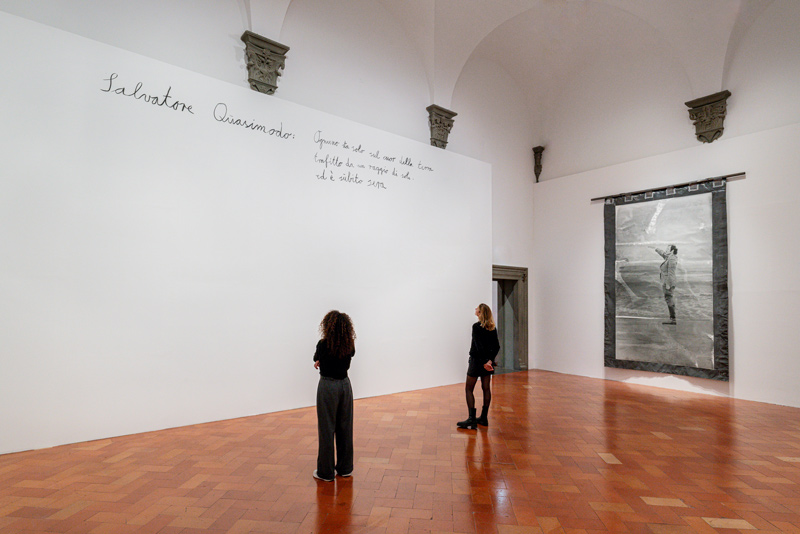
Myth and memory themes appear in Der Rhein (1982–2013), Dem unbekannten Maler (2013), Daphne (2008–2011), Nemesis (2017), and Ave Maria turris eburnea (2017). The show closes with Heroische Sinnbilder (lead-printed photos, 1969) on Nazi “Occupations,” and Quasimodo’s verses inscribed by Kiefer: “Everyone stands alone at the heart of the earth / pierced by a ray of sun / and it is suddenly evening.”
Anselm Kiefer
Donaueschingen, 1945
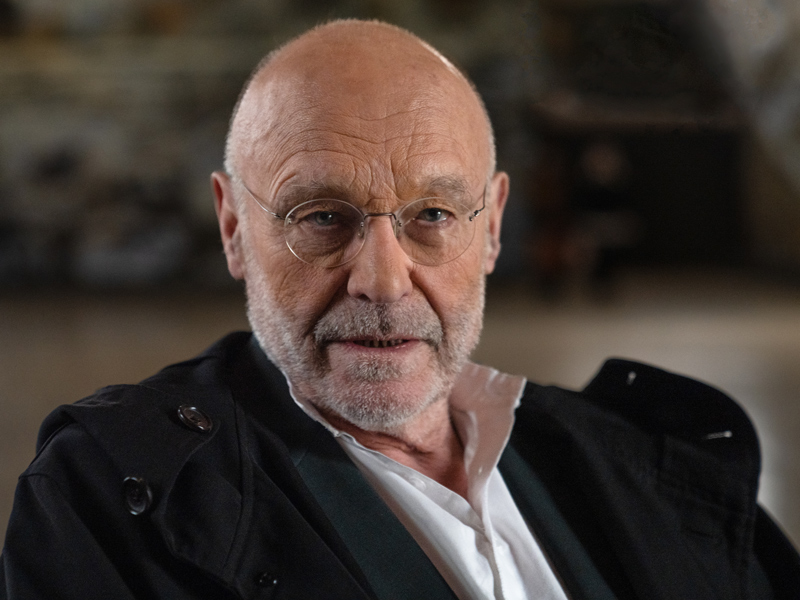
Born in 1945 in Donaueschingen, Germany, Anselm Kiefer is one of the most important and versatile artists working today. His artistic practice incorporates diverse media, including painting, sculpture, photography, woodcut, artist’s books, installations and architecture.
Kiefer studied law and romance languages before pursuing studies in fine art at academies in Freiburg and Karlsruhe. As a young artist, he entered into contact with Joseph Beuys and participated in his action Save the Woods (1971).
Early works confronted the history of the Third Reich and engaged with Germany’s post-war identity as a means of breaking the silence over the recent past. Through parodying the Nazi salute or visually citing and deconstructing National Socialist architecture and Germanic heroic legends, Kiefer explored his identity and culture.
From 1971 until his move to France in 1992, Kiefer worked in the Odenwald, Germany. Throughout this time, he started incorporating into his work materials and techniques which are now emblematic–lead, straw, plants, textiles and woodcuts–along with themes such as Wagner’s Ring Cycle, the poetry of Paul Celan and Ingeborg Bachmann, as well as Biblical connotations and Jewish mysticism.
The artist first received major international attention for his work when he represented West Germany alongside Georg Baselitz at the 39th Venice Biennial in 1980.
The mid-1990s marks a shift in his work; extensive travels throughout India, Asia, America and Northern Africa inspired interest in the exchange of thought between the Eastern and Western worlds. Structures resembling ancient Mesopotamian architecture enter the work. Glimmers of Southern France’s landscapes appear, evidenced by depictions of constellations or the inclusion of plants and sunflower seeds.
An avid reader, Kiefer’s works are layered with literary and poetic references. These associations are not necessarily fixed nor literal, but rather overlap into an interwoven fabric of signification. The interest in books being both text and object is evident in his work. Since the beginning of his practice, artist’s books have constituted a significant part of his oeuvre.
Beyond making paintings, sculptures, books and photographs, Anselm Kiefer has intervened in various sites. After converting a former brick factory in Höpfingen, Germany, into a studio, he created installations and sculptures that became part of the site itself. A few years after his move to Barjac, France, Kiefer again transformed the property around his studio by excavating the earth to create a network of underground tunnels and crypts that connect to numerous art installations.
This studio-site is now a part of the Eschaton-Anselm Kiefer Foundation, which is open to the public. The opening of the foundation in 2022 coincided with Kiefer’s return to Venice, where a cycle of paintings inspired by the writings of Italian philosopher Andrea Emo was installed at Doge’s Palace, shown in parallel to the biennial.
The exhibition Anselm Kiefer. Fallen Angels is promoted and organized by Fondazione Palazzo Strozzi.
Public supporters: Comune di Firenze, Regione Toscana, Camera di Commercio di Firenze.
Private supporters: Fondazione CR Firenze, Comitato dei Partner di Palazzo Strozzi.
Main Partner: Intesa Sanpaolo.
With the contribution of Città Metropolitana di Firenze.
With the support of Gagosian.
Thanks to Maria Manetti Shrem and Fondazione Hillary Merkus Recordati.
Cover: Anselm Kiefer, Engelssturz (det.), 2022-2023. Photo: Georges Poncet. © 2023 Anselm Kiefer