The myth still exists, writes Mark Rothko in that solitary narrative trace entitled The Artist’s Reality, the manuscript published thirty-four years after the artist’s death and edited by Christopher Rothko (C. Rothko ed., The Artist’s Reality. Philosophies of Art, Yale University Press, New Haven & London, 2004). Buried among the papers of an endless legal dispute, hidden in a folder innocuously labelled “Miscellaneous papers,” The Artist’s Reality reveals in fact nothing about Rothko the artist: no substantial autobiographical indications. One can barely identify a hypothetical milieu of writing: the early 1940s. This is inferred simply because, on the verso of one page of the manuscript, Rothko typed the draft of a letter dated 23 March 1943. A terminus ante quem, a “before,” as philologists would say.
The myth, then, somewhere in time, in the midst of global conflict, was still alive—above all because of its peculiar capacity, which Rothko attributes exclusively to the Greeks, to represent the quality of the invisible, of that which we cannot comprehend: the quality of the unknown. Greek art itself would, by its very nature, be a process of re-emergence from the depths: a way of giving form to those spectral images that settle in the muddy strata of the soul and that constitute the shape we give to the gods. This act of resurfacing would also define the contemporary artist: visions and representations become a means of giving material concreteness and visual intensity to the deep needs that inhabit the soul of every generation (The Portrait and the Modern Artist, 13 October 1943, interview with Adolf Gottlieb and Mark Rothko).
James Breslin, Rothko’s biographer, reports—albeit with some scepticism—the rumour that the artist declared his intention to suspend his artistic production for an entire year, in 1940, in order to devote himself exclusively to the study of myth and philosophy (Rothko. A Biography, The University of Chicago Press, Chicago & London, 1993). It is difficult to determine whether Rothko actually followed through on this intention; certainly, in that ominous early phase of the decade, he was reading Freud’s The Interpretation of Dreams (1899), Nietzsche’s The Birth of Tragedy (1872), and James Frazer’s The Golden Bough, first published in 1890 but still highly popular in 1940s New York—so much so as to top bestseller lists, alongside, it must be said, Mein Kampf. Frazer, the father of the anthropology of the ancient world, died in Cambridge in 1941: he was also, without doubt, the theorist of emotional survivals, of myth and belief understood as emergent traces of something hidden and partly secret—of a kind of world-soul, prehistoric, perhaps ahistorical and therefore ever-present, destined continually to ripple at the surface, revealing the invisible buried in depth across different historical periods and contexts.
Together with Frazer, his friend Adolf Gottlieb, and of course the Nietzschean dictum, Rothko shared the idea of an eternal return to myth not as refuge or escape from reality, but as its opposite. Anyone who believes that the world of today is in some way gentler and more refined than the universe of primal and ravenous passions from which these myths arise is either unaware of reality or unwilling to see it in art (The Portrait and the Modern Artist, cit.). Mythology—particularly that of the Greeks, though not exclusively—thus allows for a more vivid, more intense focus on reality.
And reality, without doubt, is now called war.
On 7 December 1942, the Metropolitan Museum of Art in New York made its twenty-eight galleries and a considerable budget available for an exhibition entitled “Artists for Victory”. The vast spaces were emptied of masterpieces which, at the outbreak of war, had been moved to the safety of underground storage. It was, in any case, a revolution for the Metropolitan, which until then had been reluctant to exhibit contemporary artists, especially Americans (Rothko. A Biography, cit.); it had also been unthinkable, only months earlier, to imagine art serving wartime propaganda.
Rothko and Gottlieb, along with many other artists, responded polemically to the Metropolitan’s initiative by participating in two “protest exhibitions” organised in close succession to “Artists for Victory” in January–February 1943. On that occasion, Rothko exhibited several mythological works, including A Last Supper, The Eagle and the Hare, Iphigenia and the Sea, and The Omen of the Eagle, partly inspired by the saga of the Atreidae and thus by Aeschylus’ Oresteia.
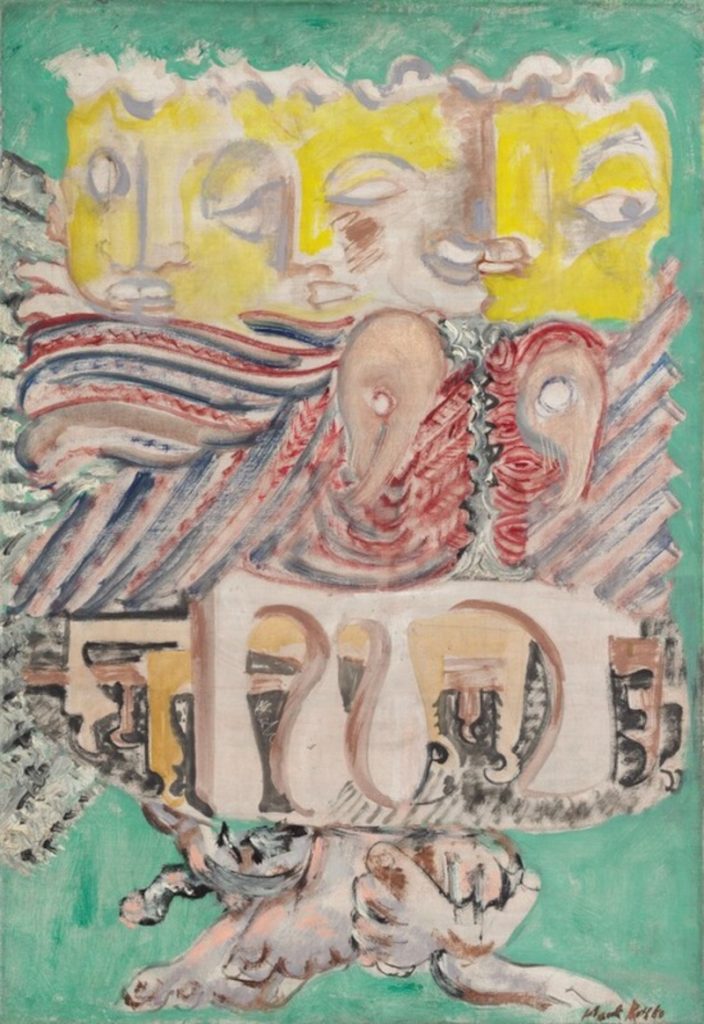
Some mythological works, such as Antigone and Oedipus, had already been shown on the eighth floor of Macy’s in January 1942, as part of a commercial exhibition devoted to contemporary American painting. However, it was only a year later that Rothko refined, through the loosely connected trilogy The Eagle and the Hare, Iphigenia and the Sea, and The Omen of the Eagle, his project of fusing the archetypal, ancestral, eternal dimension of myth with the hic et nunc of history. In particular, The Omen of the Eagle provides a chromatic proscenium for the famous prophecy that opens Aeschylus’ Agamemnon (vv. 113–134).
The chorus has just entered with solemn steps when the sky of the verses opens to reveal the flight of two eagles, one white and one black, arriving from the “favourable” side—that from which weapons are customarily raised, that is, from the right. Defined in the tragic text as “kings of the air,” they descend from the heavens and devour a hare heavy with young. A mournful song then rises in the ancient cavea of the Theatre of Dionysus in Athens, which likely hosted the performance of the Oresteia in 458 BCE: the hare is sacred to Artemis, and the eagles’ violence may displease Apollo. Divine favour is not guaranteed. The omen is nevertheless favourable, though stained with blood. The eagles are the Atreidae, and the hare, naturally, is the enemy Troy, repository of wealth. At the same time, the omen evokes the sacrifice of the “hare” Iphigenia, immolated by her father Agamemnon at the Sea, in the Gulf of Aulis, so that the vast array of Achaean ships might catch the winds needed to reach Troy.
The Omen of the Eagle is divided into horizontal bands according to a schema not unfamiliar in Rothko’s early 1940s painting. It is also, inevitably, connected to the public representation of myth in Greek art which, at least since the Parthenon frieze, is structured in hierarchical registers accommodating gods, heroes, and anthropoi, reflecting the complexity of a universe in which divinity must both appear and withdraw. The god must project outward—larger, heavier than the human form—yet at the same time present itself to the gaze as an invisible body. The immortals inhabit the upper register in The Omen of the Eagle: yellow, radiant, dazzling, arranged in pairs, like the ghostly banqueters of the realm of the dead in Etruscan tombs. Winged motions in blood-red swirls evoke the eagles in one of the central bands; below, perhaps temple-like architectures; and at the bottom, immersed in watery brushstrokes, human feet and animal claws.
These are archetypal images, generic slaughters: this is what Rothko suggests. Within this mythic amalgam of gods, humans, birds, and beasts emerges a landscape in which carnage is an archetype that spares no one since the time of the first great war of Western literature, that of the Iliad. And yet, just as in 1942, the eagle was a symbol of both Germany and the United States.
If here too the artist paints a universal within the detail of the eagle’s wing, it must also be said that the choice of the Atreidae was certainly not accidental. On 3 June 1943, Jean-Paul Sartre staged Les mouches (The Flies) at the Théâtre de la Cité in Vichy-occupied Paris, amidst the stench of refuse and decay: the saga of the Atreidae becomes a means to denounce the moral swamp in which France finds itself, immersed in unease and guilt for its acquiescence to Nazi occupation. The god, unlike in Rothko’s works, makes no attempt to distance himself symbolically from human time, but roams the city of Argos—standing in for Paris—surrounded by flies, insect-like masks of the Erinyes.
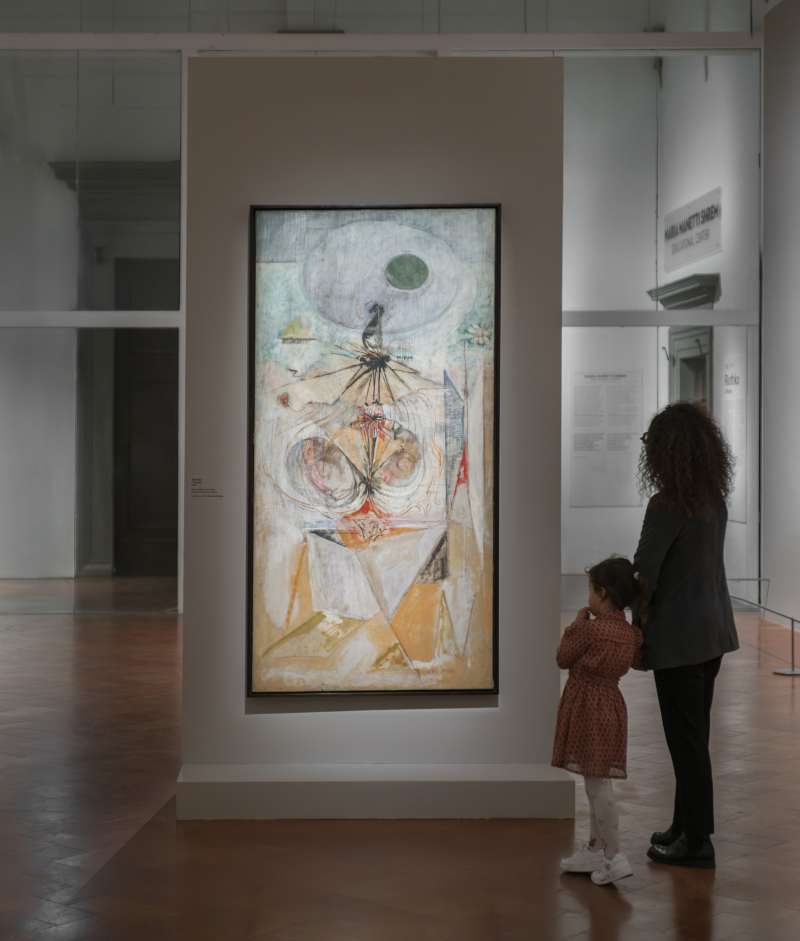
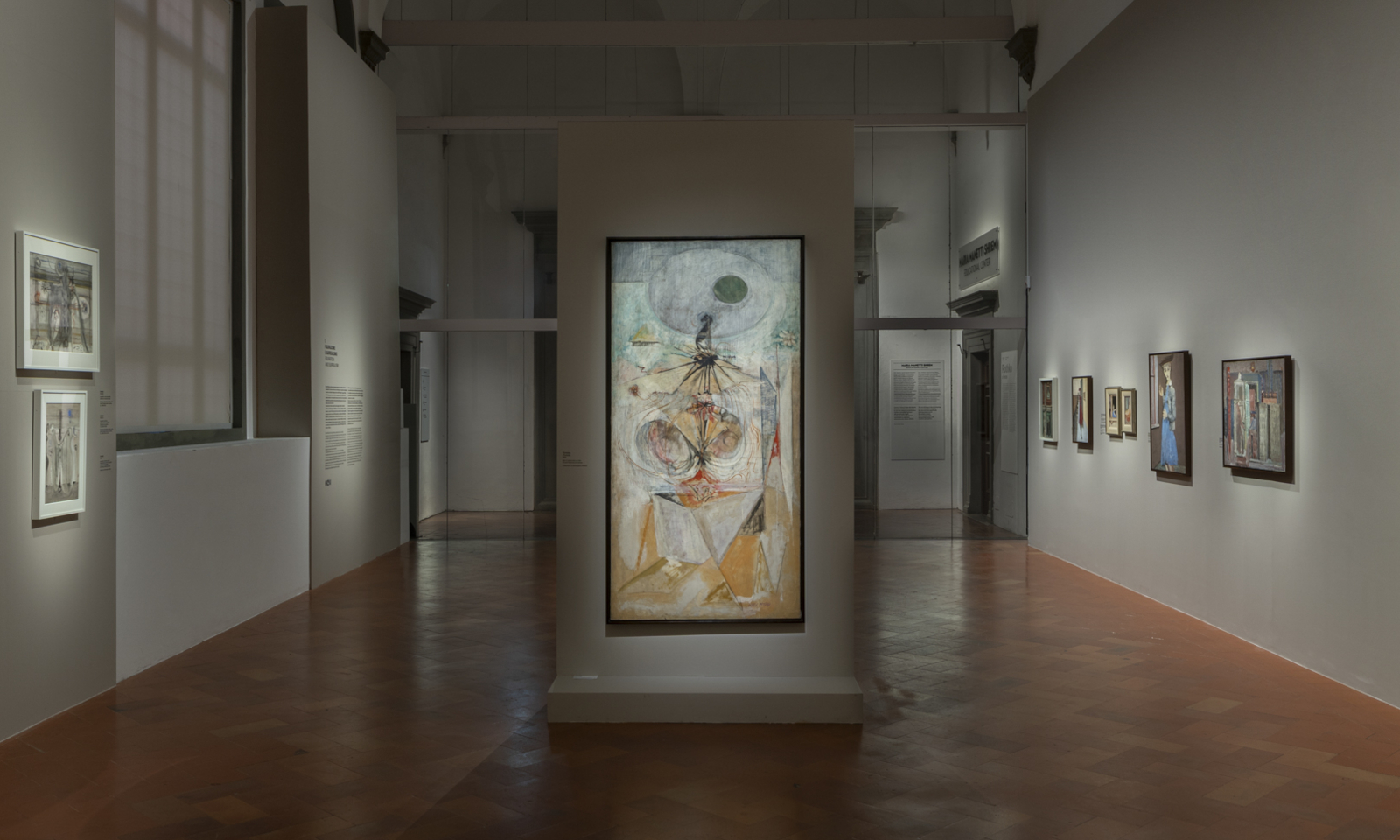
(Rothko a Firenze, exhibition views, Palazzo Strozzi, Firenze, 2026. Photo Ela Bialkowska, OKNO Studio)
In the myth of the Oresteia, it was the seer Calchas who interpreted the prodigy of the two eagles, identifying them as Agamemnon and Menelaus and attributing to Troy the semblance of the hare. Another seer emerges on Rothko’s canvas: Tiresias (cat.), completed in 1944. Christopher Rothko, in Mark Rothko: Inside the Work (Marsilio, Venice, 2026, p. 265), recalls how the large canvases Tiresias and Rites of Lilith belong to a new, intense and passionate phase in the artist’s production, linked to the arrival of Mell—Mary Alice Beistle, Christopher’s mother—into Rothko’s life.
Tiresias, in particular, results from Rothko’s long engagement with the ambiguous and polymorphous figure of the Theban seer. Its duality recalls Oedipus, from a few years earlier, and becomes a perfect laboratory for grafting the unfathomable radicality of tragic myth—with Tiresias, like Oedipus, a protagonist—onto biomorphic elements that interweave symbolic and archetypal details such as totemic heads, body fragments, and skeletal masks.
Tiresias is itself a perfect biomorph: conceived as such from the outset, not only because of the seer’s famed blindness, but because of his unique status in Greek mythology. He alone was granted a double transformation of gender—from male to female and from female back to male—thanks to a single impulsive act: separating, twice, a pair of mating snakes encountered along his path.
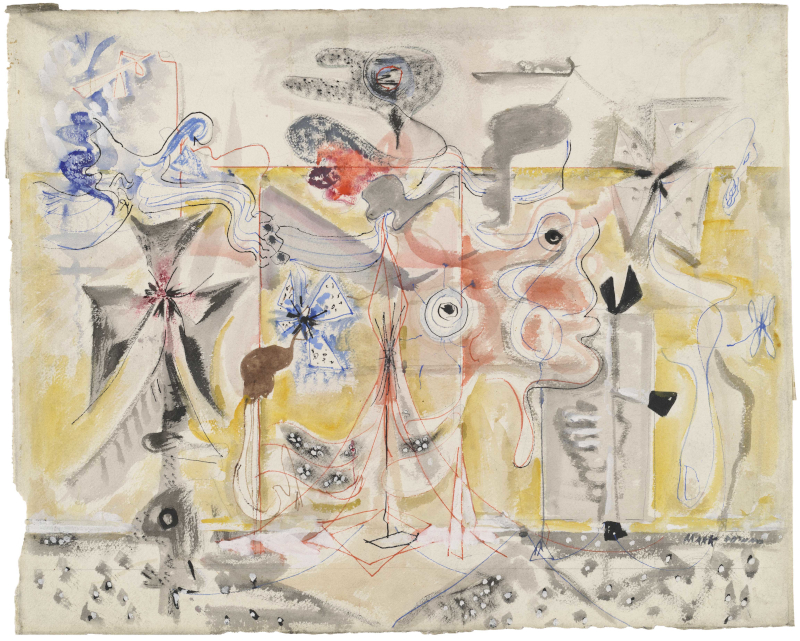
Tiresias and the floating untitled those years represent a necessary completion on the level of mythic narration: the painter, the artist, is now an explorer, an archaeologist of the invisible. It is Sigmund Freud who opens the door to the inner self, suggesting the equivalence on which the entire theory of the unconscious is based: the dream world is to the individual what myth has always been to the collective. The same grammar, the same syntax, the same vocabulary. Freud himself acknowledged to his close friend Wilhelm Fliess his debt to Sir Arthur Evans, the discoverer of Minoan civilisation, and the productivity of “archaeological metaphors” in psychoanalysis (S. Freud, Letters to Wilhelm Fliess, 1887–1904, Bollati Boringhieri, Turin, 1986, especially 5 July 1896, pp. 478–479).
Thus for Rothko as well: the artist is now called, like an archaeologist or anthropologist, to dig deep in order to bring to light—through painting—the archetypal traces of myth that lie buried alongside the most secret impulses of the individual. Myth is something real and existing in ourselves. Thirty years earlier, Jane Ellen Harrison, the first great female Hellenist, had argued that this is how one must speak of the gods and the sacred: as a powerful emotion experienced individually or collectively, something stronger than the individual and difficult to decipher. Unable to define such an overwhelming emotion or to locate its origin, the believer ultimately surrenders, renounces reason, and calls this unfathomable feeling divinity (Themis: A Study of the Social Origins of Greek Religion, 1912).
Harrison grounded her seminal insights on Greek myth and religion not so much in literary texts as in the “monuments of ancient Athens,” as well as in the biomorphic and shifting arabesques of William Morris’s fabrics and Pre-Raphaelite painting.
Perhaps, then, that ancestral and secret emotion—too powerful for human reason—does not arise solely from proximity to the divine or to myth, but also from the experience of encountering a work of art.
Silvia Romani, an anthropologist of the ancient world and professor at the University of Milan, explores classical myths and religions through a contemporary and cross-disciplinary perspective. Among her recent works: Saffo. La ragazza di Lesbo (2022), La Sicilia degli dèi (2022), Omero. Delle armi e del vero amore (2024).
On the cover: Rothko a Firenze, exhibition views, Palazzo Strozzi, Firenze, 2026. Photo Ela Bialkowska, OKNO Studio