-“Children are not interested in the artistic product, but in the relationship, in what the work triggers, Chiara Guidi used to say”.
-“Or as Rodari said, children know one thing more than grammar!”
(Conversation after an evening gathering)
The air of a bewildered student, a numinous canvas, and the moment of peering out. My heart is an empty vessel resting on the brazier — the exposed calluses against the leather of the boot cut sharply, the lips dry, held firm by hollowed cheeks and a defiant gaze. Only what is happening now has meaning. One must hold back with patience, with creative will, with that force of anguish1 that belongs to the poet as much as his ineptitude. The silence is emphatic, opaque, the façades swallow the light — the more I observe them, the more they disappear… guiding me to do the same. Though empty, the bag bends my back — a sacred, hunching pain — I remain vis-à-vis. “What does it mean?”, “Why that colour?” — I hear the questions posed in order to understand, uncivil for a dialogue. The answer is already here, why interrupt it? I am here to continue a discourse. It overtakes me and I accept it. The only question I manage to set against it is inward: from what point should one look?
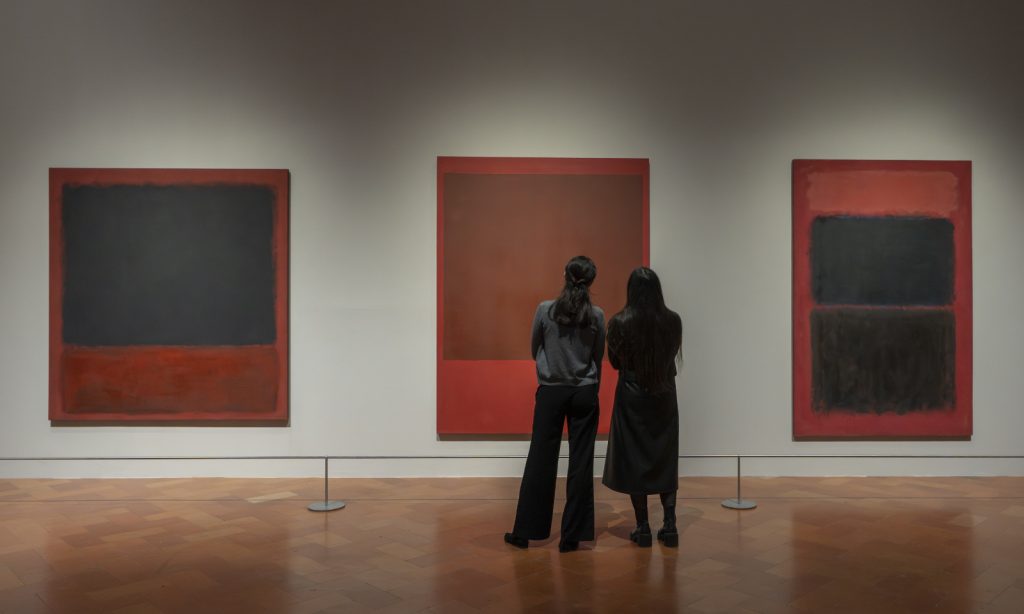
In my hand, two books cling to one another out of necessity, each keeping the other’s place between the pages: “Sonečka” by Marina Tsvetaeva and the “Writings” of Mark Rothko. It is an unforeseen inevitability — the words feel they have the necessary space to flow. And no, I must not hastily cling to Newman’s words2, the new painters, the distinction between the plastic and the plasmic — it is oil paint that carries one elsewhere, and elsewhere is different for each of us. I must dare one step further, become Antonio Verri as he crosses Umberto Palamà’s Space-Time Door3, move beyond the canvas severed at the edges, following the perimeter of the frame, because there was never any canvas at all. Before these altars converges the desire for the unknown. It allows me to trace a road, a path that does not open onto visible spaces — limited, too wakeful — but onto vision itself. To open a path is to open a void, repeated and unequal, toward the centre of all centres, the axis — and within the work remains the tension, the obsessive intention, of our attempts to grasp the primordial. We go searching for it in art, between narrow freedoms and prisons too vast, in movement — of which Romano Gasparotti4 spoke — in dance, hunting for reminiscences. I sense Sonechka fleeing the theatre pursued by Stanislavski — the month of April, his conversations before Marina, that frenetic friendship5. It is the very same red — shining, the cover of the book and the painting alike — a consumptive flush6; the freezing nights, the hunger all around, and yet within herself Marina did not betray colour — joyful, like Sylvia Plath’s temperament that allowed her to ennoble the sky with blue and give grass its green7. The absolute power of feeling. The poet is response itself, a scorified posture stripped down to feel only what is essential, the single indispensable word that alone reveals — and to utter only the language itself. Not yet art, and yet already more than art.
It is Mark Rothko who says, Some artists want to say everything. I think it is more profound to say little8, and he lists the ingredients necessary to do so, to make painting. And why not adopt them instead as the necessary ingredients for experiencing it? First, the awareness of death — what colour does it have? The pallor of a bruised corpse? Not at all: the colour of sweet Sonečka! The vivid colour of the hero. Of one who has chosen to burn in order to warm others9 — and conscious eyes are heroic eyes. Second, sensuality — hers, before the soldiers while performing Nasten’ka in White Nights — in her little dress, a sweetly smiling muse who says “grey” instead of “banal.” The girl one loves sleeplessly; she is the first to know it: I myself am a white night. Third, tension — the elastic force of life, the ingenious defusing of the lacerating machine we carry within us. The moment in which we are called to choose, those gestures, that way of carrying them out. They seem to say who we are — whether we like it or not — and who are you, Sonečka, when you list the reasons why you granted a kiss you did not wish to give — But if I hadn’t kissed him, I would never again have dared to play Juliet.
Fourth, irony… (the Greeks had no need of it) — but what of poets? Or Socrates? Dialogue originates in fictions and opposites! Irony is the only means through which to narrate the destiny of the world — or even merely one’s own, in order to escape it — with a distant gaze, tinting it pink, like the coffin the young lady desires. To imagine aloud — Mine should be pink. So please, be kind enough to give me a pink one.
Fifth, wit, humour — contained within a reddish trunk where Sonečka keeps her bridal trousseau. Before every proposal, already possessing a white dress, orange blossoms — this too is an answer before the question, and thanks to the Sixth — the ingredients that follow — with a few grams of the ephemeral and the accidental, triumphing over ab-so-lute Mediocrity. Despite everything, when necessary there must be a Seventh, ten percent hope, a green armchair upon which to live, deep and impenetrable — and the remaining ninety is surrender; but without that ten percent Sonečka would have no place to return to, nowhere to await a friend who will listen to all her truths.
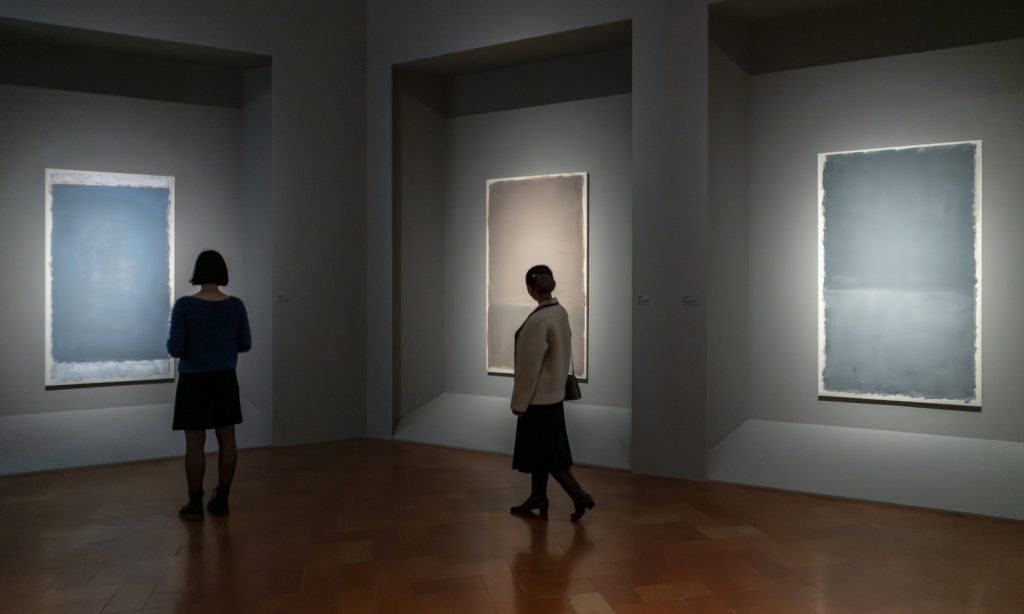
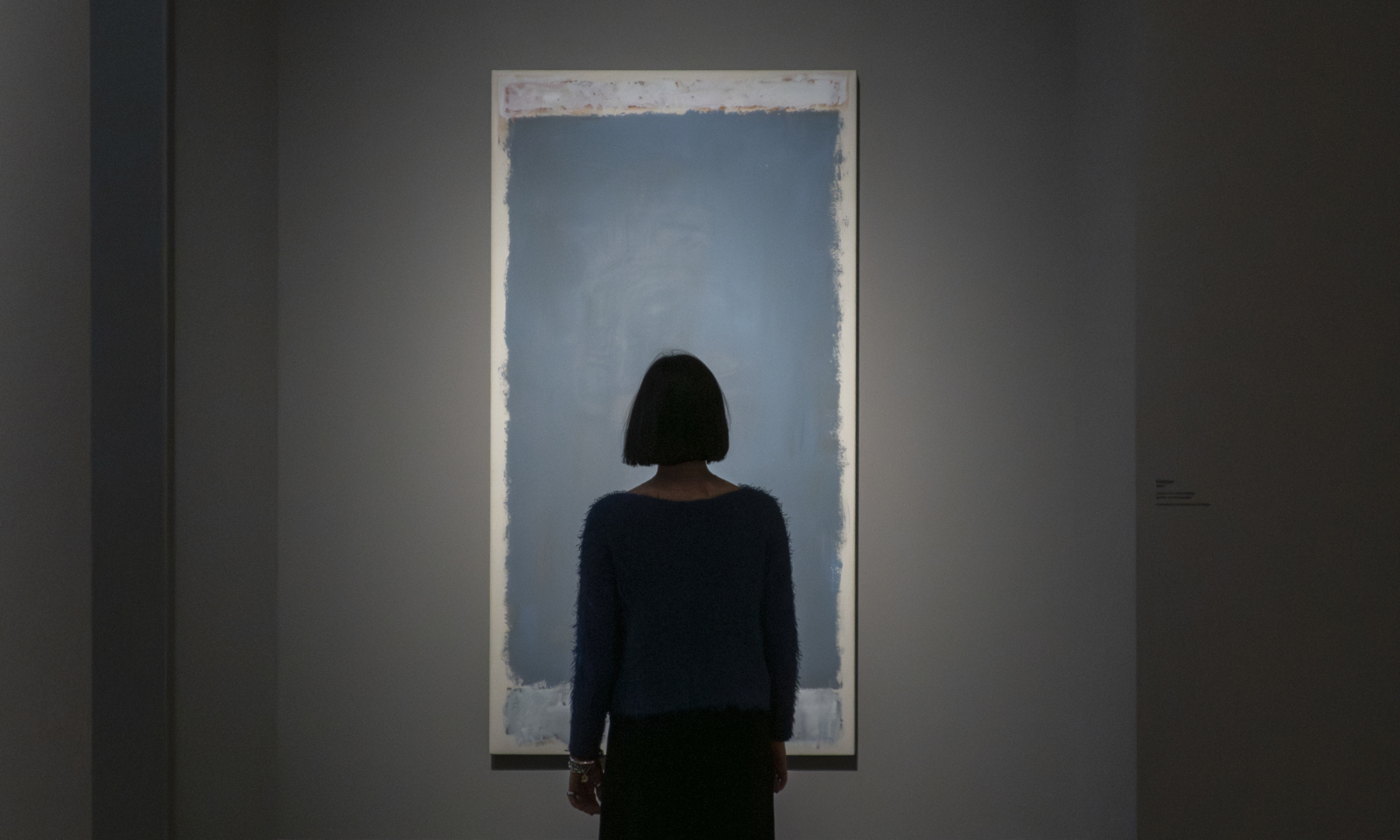
The final room — before the shop, the catalogue, the bookmark and the poster — the last glance I reserve for Untitled, dated 1969. An acrylic child disturbs the stillness, her vocal cords delicate: “This is the sky!” She is absorbed by the vast dimensions of the painting in an instant, along with her hair clips, ballet flats, and childhood name. Along with the words, larger than her mouth, as spontaneous as lifting peach slices from the pit. This is the sky — a blue dream beginning to exist a millimetre above the ground, a thin interval unrolling into a boundless mystery. But now it is wonder — for the parents, the tourists and the guides, the students and the teachers. What you have said belongs to everyone’s gaze now, an alphabet painted within the heart10. Say what you feel, child, say what you see — do not question it. The point from which you look… I would make myself smaller and smaller until I could reach you — tiny, reduced to grains of rice. Outside this place no one sleeps, and I, too, shall have a new happy secret. A sheet of laid paper will bear witness for me.
Riccardo Pedicone was born in Pordenone and moved to Milan at the age of seventeen. He worked as an author in the fields of podcasting and radio before focusing entirely on his literary and educational projects. In 2021 he made his debut with his first book, “L’inesatto attimo in cui siamo morti”. In 2024 he published “Nasco oggi, ora lo so” and launched the “Diagonale” series with Do it human. In 2025 he published his third book with Rizzoli, “E sembra quasi vero”, and launched the literary podcast “Felici Pochi” on YouTube and Spotify. In 2022 he founded the cultural association NOCE, of which he is currently president.
- “Il poeta e il tempo”, Marina Cvetaeva, ed. Adelphi. ↩︎
- Barnett Newman, testo di riferimento “Il sublime, adesso”, ed. Abscondita ↩︎
- Dal catalogo “VERRI Antonio Leonardo – Una stupenda generazione”, fotografia scattata ad Antonio Verri mentre attraversa l’opera dello scultore Umberto Palamà tenendo tra le mani il “quotidiano dei poeti”. ↩︎
- “Sulla danza”, ed. Cronopio ↩︎
- “Sonečka”, Marina Cvetaeva, ed. Adelphi. ↩︎
- “Il flauto di vertebre” – “Poesie d’amore”, Vladimir Majakovskij, ed. Einaudi ↩︎
- “Io/se di umore lieto, /do all’erba il suo verde, /blasono il cielo d’azzurro e al sole /dono l’oro” – “Soliloquio della solipsista”, Sylvia Plath. ↩︎
- “Scritti”, Mark Rothko, ed. Abscondita. ↩︎
- “Gli Imperdonabili”, Cristina Campo, ed. Adelphi. ↩︎
- “Il cuore /che avevo a scuola /dov’era dipinto /l’alfabeto,(…)”, “Ballata interiore”, Federico García Lorca. ↩︎
On the cover: Mark Rothko, Untitled, 1969, Collezione Christopher Rothko. (Rothko a Firenze, exhibition views, Museo di San Marco, Firenze, 2026. Photo Ela Bialkowska, OKNO Studio).