“What do you see?”: this is the first question John Logan gives his Mark Rothko in Red. But it is also the question inevitably asked by anyone entering a room devoted to his paintings. Faced with the large canvases of his mature period, we are inclined to search for a meaning, a hidden image, a story. Rothko, however, seems to ask something else of us. His question is not what we recognise, but how we look.
When I began directing Red at the Teatro dell’Elfo in 2013, in Matteo Colombo’s translation, I realised that the challenge was not to stage the biography of a painter. John Logan had written neither a documentary play nor an art history lesson: he had created a theatrical device capable of bringing the audience closer to the experience of Rothko’s painting. The challenge for the director was therefore to give the theatre the time, silence and intensity of vision demanded by his works.
For this reason, the audience did not take their seats in front of a closed curtain. They entered the painter’s studio directly.
Ferdinando Bruni, playing Mark Rothko, was already there, seated in the half-light before a large canvas. He was not acting: he was waiting. Or perhaps he was doing what Rothko considered an essential part of his work: studying the painting. The atmosphere was suspended, accompanied by barely perceptible music. Shortly afterwards, a shy, wary young man entered. He approached the painter and held out his hand, but Rothko, without speaking, simply invited him to look at the painting. Only later would the audience understand what “studying” a canvas meant to the Rothko imagined by Logan.
The young man is Ken (Alessandro Bruni), who has arrived for a job interview. Rothko subjects him to a kind of initiation test, to determine whether he possesses the sensitivity required to approach painting. From that moment onwards, the painter begins to reveal to him—and, through him, to the audience—the creative process that precedes the birth of every work.
It was precisely this concept of waiting that guided our work. In Rothko’s studio, time does not coincide with the time of theatrical action. A painting continues to change even after the painter has stopped working on it: it must be observed, questioned and even challenged. Only after spending many hours in front of his paintings did I understand that the true action of Red lies not in the words spoken by the characters, but in the gaze continually directed towards the canvases.
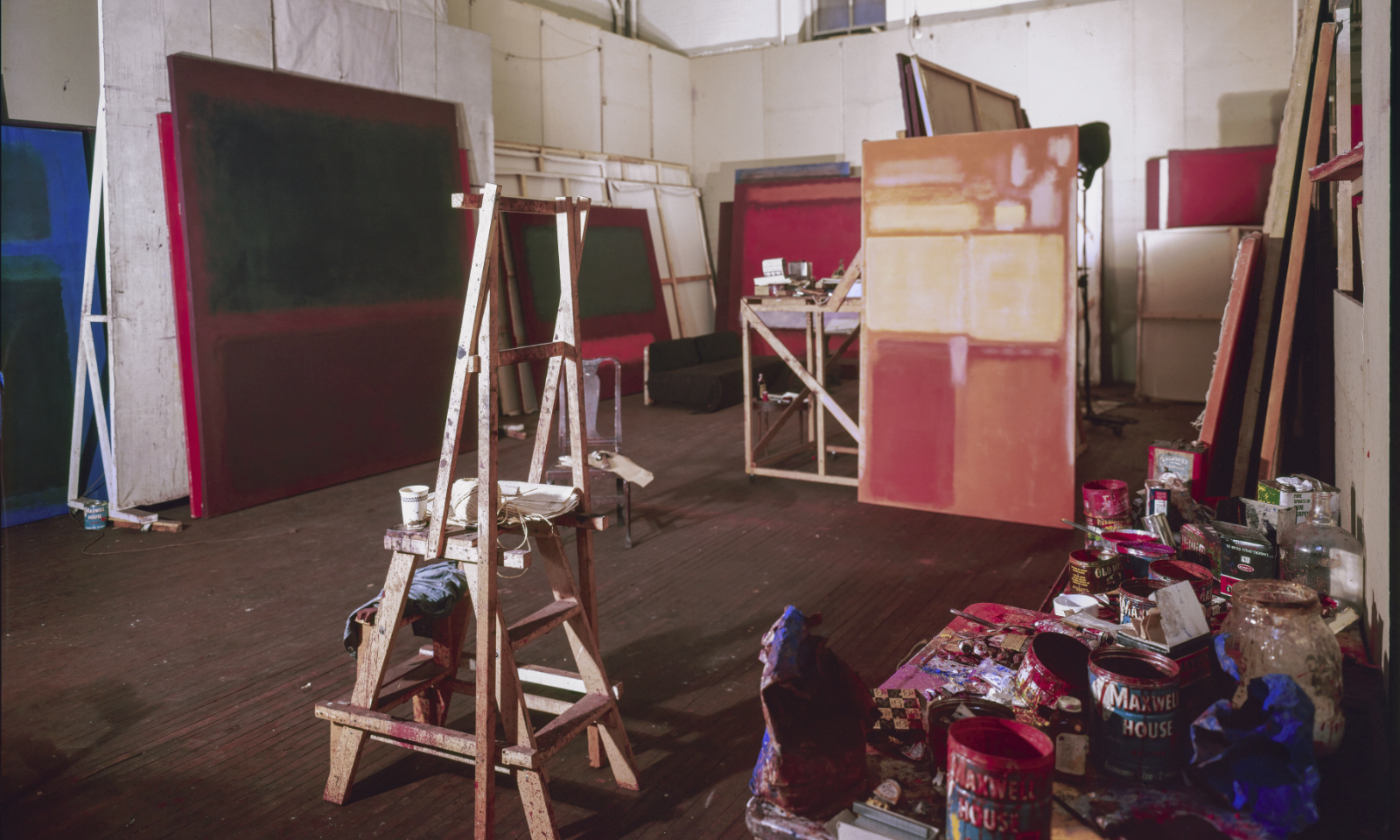
In his opening stage direction, Logan sets the action in “Rothko’s studio, 222 Bowery, New York. Circa 1958–1959”. I decided to follow this instruction closely, reconstructing a space as similar as possible to the real one. Photographs of the studio inspired the large structures used to support and move the canvases intended for the Four Seasons, the restaurant designed for the Seagram Building. More than a scenographic choice, this was an attempt to provide the actors with a credible working environment, capable of conveying the physical reality of making a painting.
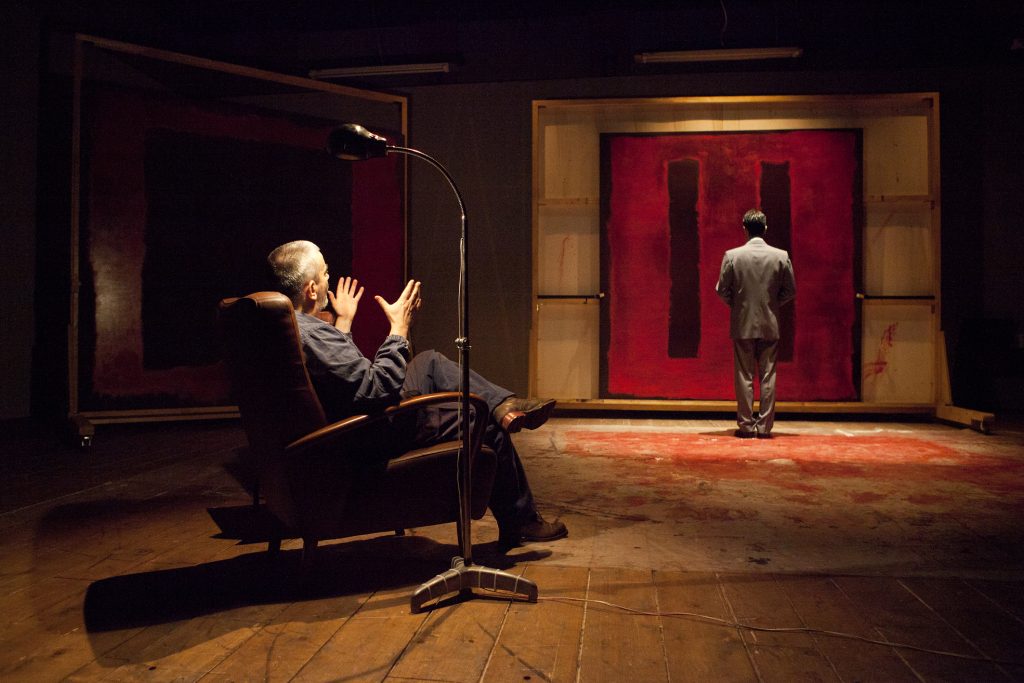
As Ken looks at the paintings and tries to describe the emotions they evoke, Rothko reveals that the canvases are intended for a restaurant. The young man’s surprise is followed by one of the play’s key exchanges:
ROTHKO
One day I’m minding my own business when I get a call from Mr Philip Johnson. He’s designing the new Seagram skyscraper on Park Avenue, with Mies van der Rohe. This building will contain a restaurant called the Four Seasons… and on the walls of this restaurant…
In just a few lines, Logan defines the character of his Rothko: ironic, brilliant and fully aware of the prestige he has achieved. By the end of the 1950s, he had become one of the central figures of Abstract Expressionism, and the Four Seasons commission represented the public recognition of that position.
After a moment’s hesitation, Ken asks a question that is only apparently naïve.
KEN
Are these finished?
It is a crucial question, because it introduces one of the central themes of the play. Logan constructs his Rothko by drawing on the artist’s statements and writings, presenting the image of a painter for whom the physical execution of a painting constitutes only one stage of the creative process.
ROTHKO
I’m working on them. Now I have to study them.
ROTHKO
All my life, all I’ve ever wanted was to create a place… a place where the public could live in contemplation of the work and devote to it at least some of the attention and care that I have devoted to it.
KEN
But… it’s a restaurant.
ROTHKO
No… I will make it a temple.
This exchange reveals one of the play’s fundamental tensions. A painting does not end when colour is applied to the canvas: it continues to transform itself in the gaze of the viewer. Logan translates into theatrical terms a conception of painting deeply rooted in Rothko’s thought: the work is not an object to be contemplated, but an experience capable of engaging the viewer inwardly.
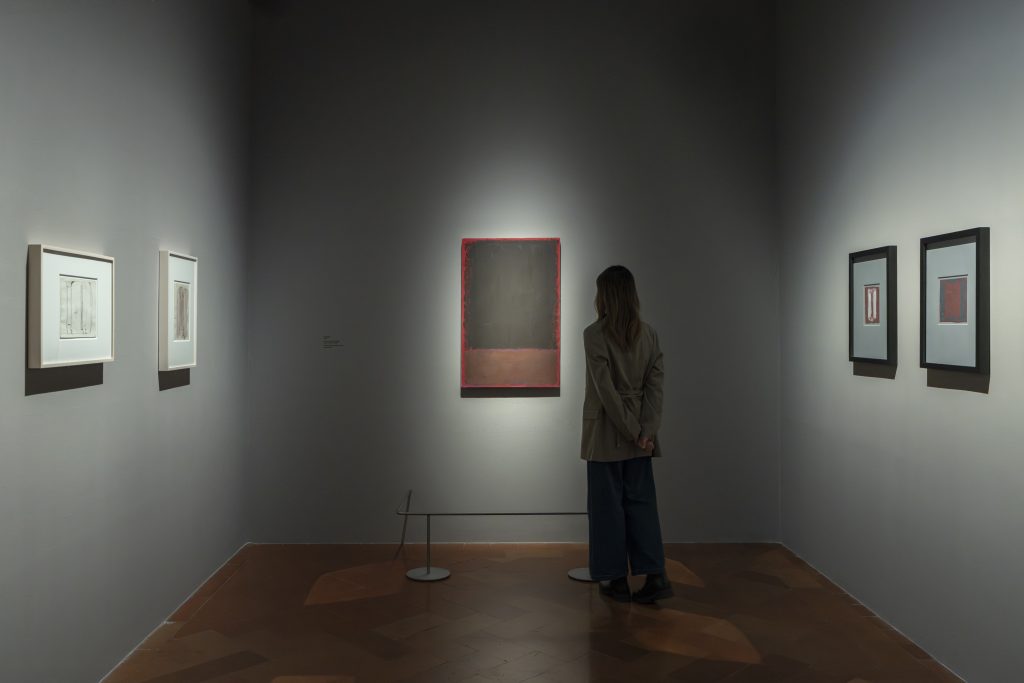
By the end of the 1950s, Rothko had achieved international recognition, but success did not lessen his contradictions. The prestigious Four Seasons commission placed him at the centre of the American art system while, at the same time, forcing him to question the relationship between artistic creation, patronage and the market.
In Red, the economic dimension is far from secondary. Logan introduces it naturally, showing how the artist’s research coexists with the mechanisms of the market and the contradictions of 1950s New York. On the one hand, Rothko imagines a contemplative space capable of transforming those who enter it; on the other, that space is destined to become a symbol of triumphant capitalism. It is precisely this tension that makes the story of the Seagram Murals one of the most fascinating episodes in the history of twentieth-century art.
The most demanding directorial decision, however, concerned the paintings.
We could have used high-resolution photographic reproductions. That would have been the simplest solution. During rehearsals, however, we realised that those images remained mute. We therefore decided to paint the large stage canvases ourselves. Not in order to imitate Rothko—an impossible undertaking—but to understand his working method. We applied ground layers, built up glazes and altered the relationships between colours, trying to understand how one colour could breathe through another. It was a theatrical exercise, but also a different way of studying a painter.
Logan continually interweaves artistic reflection with personal experience. In one of the play’s most intimate moments, Ken recounts an episode from his childhood that leads him to reflect on the emotional value of colours. This memory also prompts Rothko’s own account, as he recalls his family’s arrival in Portland in 1913, the ghetto, his real name, Marcus Rothkowitz, and his subsequent transformation into Mark Rothko. The change of name thus takes on a symbolic significance: it marks the construction of a new artistic identity.
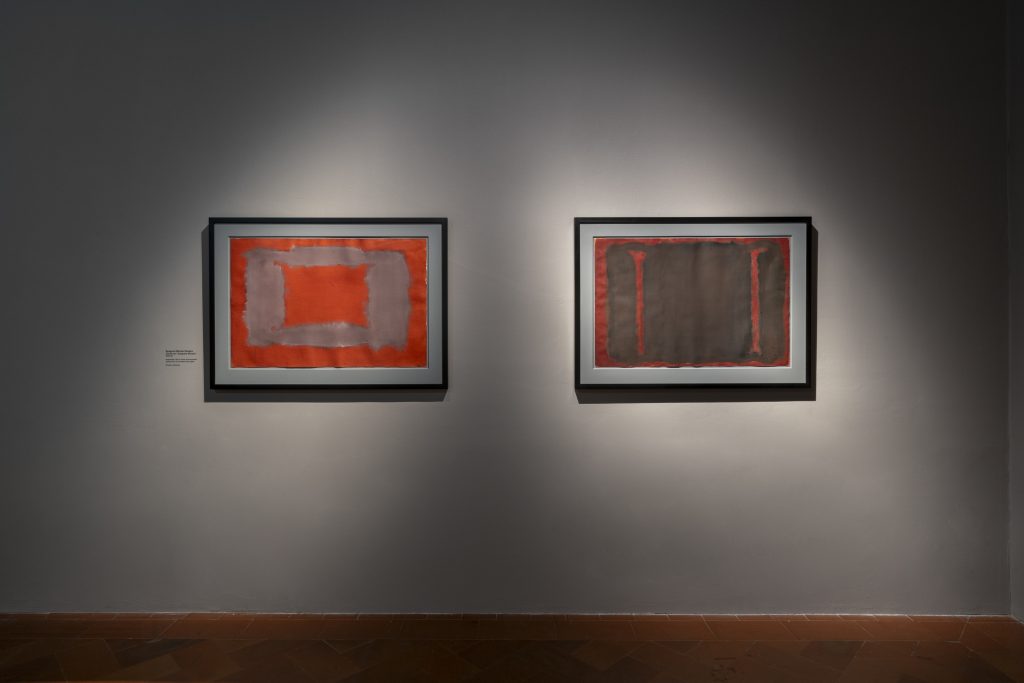
For the director, however, the principal challenge was not to reconstruct the painter’s biography, but to give physical form to his thought. Once the text had been translated, the work with Ferdinando Bruni began. Even before rehearsals, we spent a long time studying the paintings, seeking to understand their construction, the pentimenti concealed beneath the glazes and the rhythm of the painterly gesture. Our decision to produce the canvases ourselves arose precisely from this need: to understand Rothko through the act of making.
It was probably the decisive moment in the entire creative process. Directing ceased to be an exercise in representation and became an experience of discovery.
The smell of oils, pigments and solvents filled the theatre. Only then did we realise that this was altering our perception of the production. The audience no longer felt that they were watching the reconstruction of a studio: they felt as though they were actually entering one. Logan’s words acquired a new materiality because they were immersed in the very substance of which they spoke. Painting ceased to be the subject of the production and became its substance.
At one point, Logan gives Rothko one of the play’s most intense monologues. Exasperated by the rise of Pop Art, the painter launches into a violent attack on an idea of art reduced to surface, consumption and entertainment. “When I hear the word ‘pretty’, I feel like throwing up,” he says with brutal honesty.
His is not merely an attack on a new artistic movement. It is the fear of a man who senses that his time is changing and sees the language he helped to create suddenly at risk of becoming obsolete. He feels besieged by the market, by dealers and by fashion, within a system prepared to transform every work of art into a commodity.
Imagining that the paintings themselves are speaking, Rothko gives voice to what, in his view, every work should demand of its viewer:
ROTHKO
“I exist to make you think… not to create pretty pictures.”
This is probably why Rothko’s work continues to exert such a distinctive power. His large rectangles of colour do not ask to be interpreted, but inhabited. They demand time, silence and openness. Logan translates this experience by inventing the character of Ken, who gradually learns how to look; the director, in turn, cannot simply recount that process, but must recreate the conditions that make it possible. In this sense, Red is not merely a play about painting: it is a play about looking.
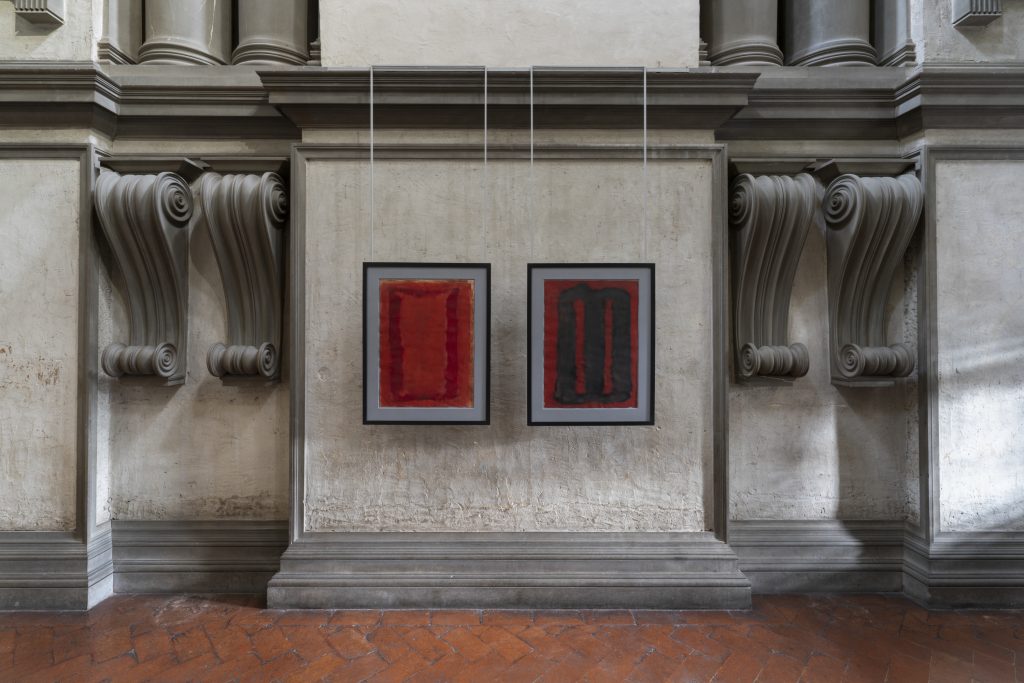
In the final part of the play, Logan introduces one of the most significant episodes in Rothko’s biography: his journey to Italy and his visit to Michelangelo’s Laurentian Library.
ROTHKO
“If you ever go there, remember to look for the staircase. Michelangelo created a space in which the doors and windows seem to have been bricked up. Anyone who enters finds themselves trapped, with nothing left to do but bang their head against the wall. That is the same atmosphere I wanted to create at the Four Seasons… I know perfectly well that it is where the richest assholes in New York will go to eat and show off. And frankly, I hope to ruin the appetite of every single son of a bitch who goes there.”
In this monologue, Logan condenses the meaning of the entire story of the Seagram Murals. The commission represents more than a professional success: it becomes a test of painting’s ability to resist the context in which it is placed. The paintings are not conceived to decorate a luxury restaurant, but to transform its perception, introducing unease into a space devoted to ostentation and prestige.
The visit to the Laurentian Library therefore acquires a significance that goes beyond a simple biographical reference. In Michelangelo’s architecture, Rothko recognises the possibility of constructing an emotional space before a physical one. It is the same aspiration that animates his painting and, indirectly, Logan’s play: to create an environment capable of altering the audience’s perception of time and space.
It was then that I understood more clearly the director’s task. Not to tell the story of Rothko, but to create the conditions in which the audience might share, at least in part, his experience of looking. The set, lighting, pauses, work on the canvases and even the smell of paint acquired meaning only insofar as they contributed to that state of receptiveness and contemplation.
The play concludes with Rothko’s decision to withdraw from the Four Seasons commission. It is a well-known episode, but Logan avoids any celebratory emphasis. The final exchanges between Rothko and Ken move away from conflict and become a reflection on time, the succession of generations and every artist’s responsibility towards those who will come after them.
In Ferdinando Bruni’s interpretation, those words acquired an unexpected tenderness. Behind the master’s uncompromising attitude emerged the vulnerability of a man aware that every artistic pursuit is destined to be taken up, transformed and surpassed by others. This is perhaps the play’s most profound legacy: to remind us that art is always born from a dialogue, even when it takes the form of an obstinate solitude.
Perhaps this is also the best way to prepare oneself to enter the galleries of Palazzo Strozzi. Not by immediately searching for a meaning, but by allowing oneself the time to linger before the paintings and be affected by their presence. By accepting, at least for a few minutes, the same question Rothko asks his young assistant, and which John Logan continues to ask each one of us:
What do you see?
Francesco Frongia (Busachi, 1962) is a theatre director. His work explores the encounter between video and the stage, giving rise to a theatrical language in which images are an integral part of the dramaturgy. He has a long-standing collaboration with Teatro dell’Elfo and, since 2015, has been artistic director of the «Nuove storie» programme.
On the cover: Mark Rothko’s studio at 222 Bowery, New York. Photograph by Herbert Matter / Courtesy of the Department of Special Collections, Stanford University Libraries.