Donatello
The Renaissance
from 19 March 2022
to 31 July 2022
- Piano nobile
- Daily 10.00-20.00Thursdays until 23.00
- Ticket required
- Amici di Palazzo Strozzi: free
From 19 March to 31 July 2022 the Fondazione Palazzo Strozzi and the Musei del Bargello host Donatello, the Renaissance, an historic, once-in-a-lifetime exhibition which sets out to reconstruct the astonishing career of one of the most important and influential masters of Italian art of any age, juxtaposing his work with masterpieces by artists who were his contemporaries such as Brunelleschi, Masaccio, Andrea Mantegna, Giovanni Bellini, Raphael and Michelangelo.
Curated by Francesco Caglioti, professor of medieval art history at the Scuola Normale di Pisa, the exhibition showcases over 130 works of art including sculptures, paintings and drawings, with unique loans, some of which have never been granted before now, from almost sixty of the world’s leading museums and institutions. Hosted in two venues, Palazzo Strozzi and the Museo Nazionale del Bargello, Donatello, the Renaissance allows visitors to explore the life, works and legacy of this “master of masters.” The supreme sculptor of the Quattrocento, Donatello triggered the revolutionary age that was the Renaissance, developing new ideas and figurative solutions that were to mark the history of Western art for ever. Through his work Donatello regenerated the very notion of sculpture, combining the most recent discoveries in the field of perspective with the psychological dimension of art, embracing the full range of human emotions in all their deepest diversity.
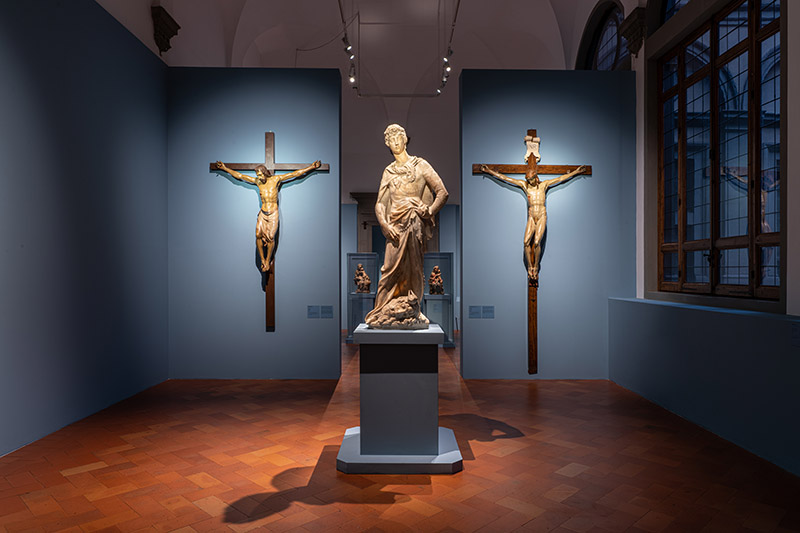
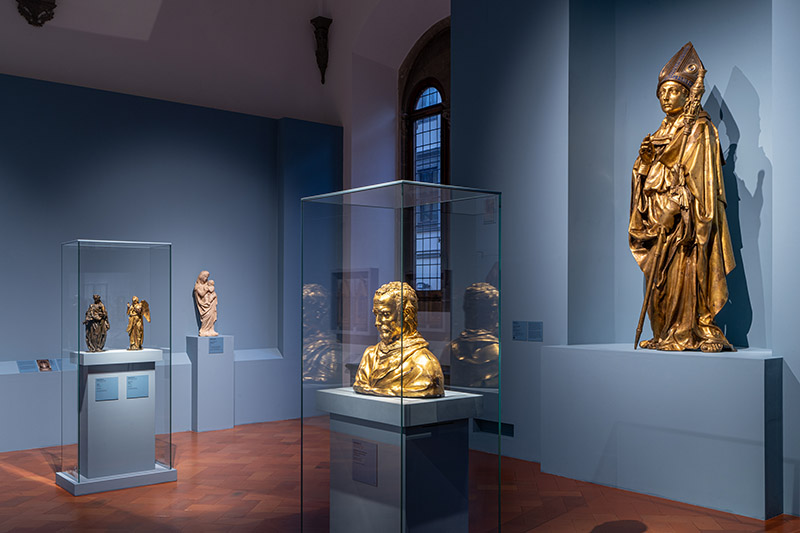
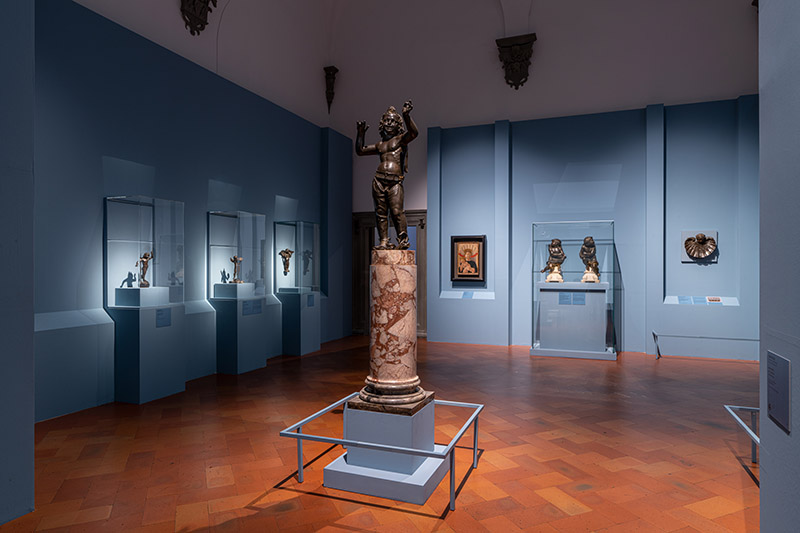
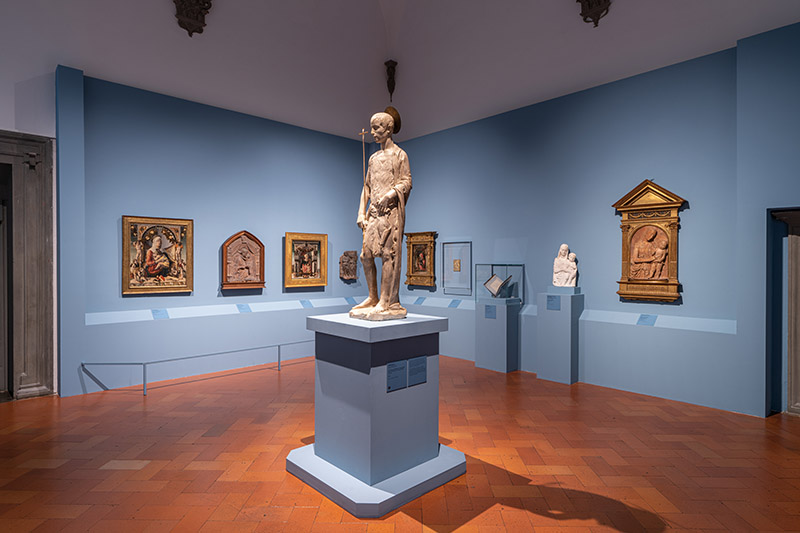
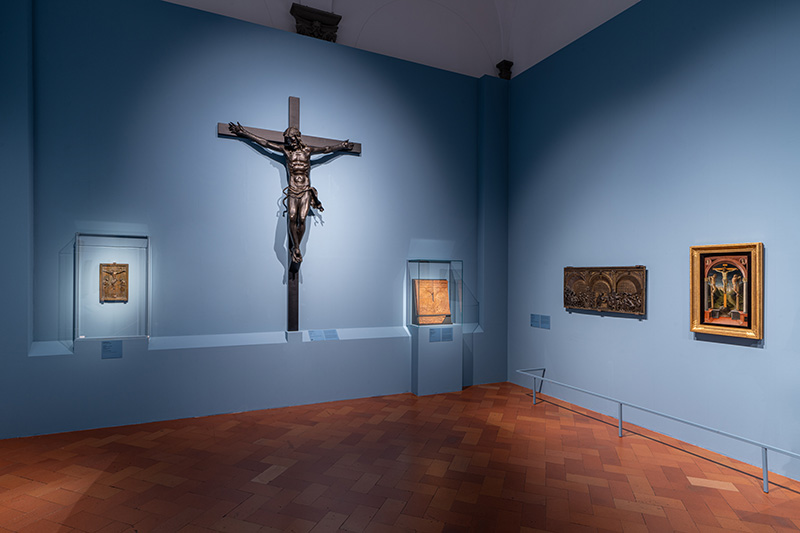
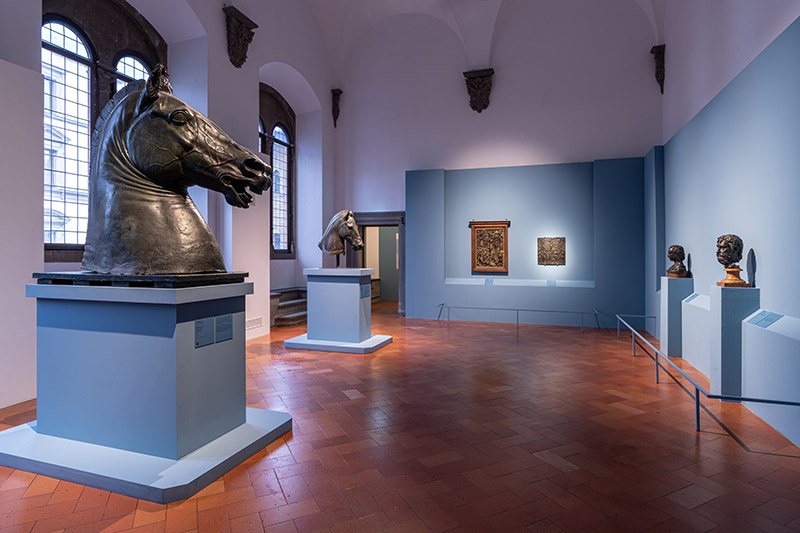
In Palazzo Strozzi, the exhibition reconstructs Donatello’s artistic career through one hundred masterpieces such as his marble David and his Amorino-Attis from the Bargello, his Spiritelli from Prato Cathedral pulpit and his bronzes from the high altar in the Basilica of Saint Anthony in Padua, in addition to numerous exhibits on loan from the leading museums of the world such as the Louvre in Paris or the Metropolitan Museum in New York. Such works as the celebrated Feast of Herod from the baptismal font in Siena or the superb doors from the Old Sacristy in San Lorenzo in Florence, only two of the fourteen works specially restored in connection with the exhibition, are also on display after leaving their homes for the first time in their history.
The exhibition continues in the Donatello Room at the Museo Nazionale del Bargello, where the exhibits include the master’s St. George and his bronze David in dialogue with other celebrated works. The final sections of the exhibition illustrate Donatello’s crucial influence on the work of Mannerist and later artists with a series of unprecedented comparisons and juxtapositions.
Exhibition walkthrough
At Palazzo Strozzi, the exhibition unfolds along a chronological-thematic path that reconstructs Donatello’s artistic biography through one hundred masterpieces, such as the marble David and the Attis-Amorino from the Bargello, the Spiritelli from the Prato Cathedral Pulpit, the Crucifix, the Miracle of the Mule, and the Imago Pietatis from the high altar of the Basilica of Sant’Antonio in Padua, in addition to numerous works from renowned foreign museums like the Louvre in Paris, the Metropolitan Museum of New York, and the National Gallery in London. For the first time in history, the Feast of Herod, Faith, and Hope from Siena’s Baptistery font are displayed outside their original context, along with the extraordinary bronze doors from Florence’s Old Sacristy at San Lorenzo—several of the many works subject to major restorations connected to the exhibition.
At the Museo Nazionale del Bargello, the itinerary features iconic Donatello works, from the marble Saint George with its extraordinary schiacciato relief of Saint George freeing the princess, to the bronze David alongside Andrea del Castagno’s detached frescoes of Filippo Scolari (Pippo Spano) and Farinata degli Uberti from the Uffizi Galleries. It continues with Desiderio da Settignano’s Martelli David, exceptionally loaned from Washington’s National Gallery of Art, followed by the Madonna of the Clouds from Boston’s Museum of Fine Arts, the Dudley Madonna from London’s Victoria and Albert Museum, and Michelangelo’s Madonna of the Stairs from Florence’s Casa Buonarroti Foundation. The section showcasing this final relief illustrates, through a series of unprecedented tight comparisons, Donatello’s fundamental influence on Michelangelo’s work and modern Mannerism.
Fotogallery
Donatello
Florence, 1386 – 1466
No artist marked the art of the Quattrocento more deeply than Donatello, a sculptor and architect whose influence was felt by entire generations of artists, with whom he developed and generously shared his skill and knowledge. His art is also remarkable for the unusual breadth of its geographical influence, stretching from Tuscany to the Veneto, the Marche, Rome and Naples in a manner comparable only with Giotto or, at a later date, with Michelangelo, Raphael and Bernini.
His thoroughly modern, transgressive temperament prompted him to ceaselessly question himself and his work, creating an unpredictable style with little regard for the fashions or tastes of the age. He was an artist who set out from the Classical world and the dawn of the Middle Ages to achieve a new way of looking at and understanding the world. Over the years, Donatello’s art became increasingly imbued with a deep pathos, probing the psychology of his subjects, and involving his audience in his personal musings. His compositions combined naturalism with the faithful observation of reality and a deep re-appropriation of the models of the past. His career is one of the most expansive and multi-faceted in the history of art because it was based on a constant pursuit of improvement and achievement.
Donatello’s art is extraordinary for his ability to use different materials in works that merge lyrical qualities with a deep humanity. Donatello uses marble, stone, bronze, terracotta, wood, stucco, embossed copper, papier-mâché, glass paste and ceramics, often in works combining different materials, and achieving an expressive impact. A distinguishing feature of his style is the use of what has become known as “schiacciato or stiacciato”, a technique that involved producing a relief with minimal variations compared to the background, to suggest the illusion of depth through numerous and very thin degrees of thickness.
The exhibition expands throughout the city of Florence and in the Tuscany, region thanks also to the collaboration with the most important cultural institutions in the area, including the opera di Santa Maria del Fiore, the Opera di Santa Croce, the Laurentian Medici Opera. and the Opera della Metropolitana di Siena, which preserve the some of the artists’ most significant – but immovable – masterpieces. The Fondazione Palazzo Strozzi has programmed a wide-ranging initiative to expand the exhibition out into the wider tuscan region and help visitors explore Donatello’s impact across Italy. Donatello in Tuscany will enhance visitors’ understanding of the region’s artistic heritage, from Florence to Siena, Prato to Arezzo, Pontorme to Torrita di Siena with an itinerary that, through a physical and digital map, will lead them to discover over 50 works by Donatello, providing visitors with a deeper immersion in Donatello’s universe. The volume Donatello in Tuscany out in May, will be published as the catalogue by Marsilio Arte, and edited by Francesco Caglioti.
Donatello. The Renaissance is promoted and organised by Fondazione Palazzo Strozzi and Musei del Bargello. In collaboration with the Staatliche Museen in Berlin and the Victoria and Albert Museum in London and with F.E.C. – Fondo Edifici di Culto.
Main Supporter: Fondazione CR Firenze.
Supporters: Comune di Firenze, Regione Toscana, Camera di Commercio di Firenze, Comitato dei Partner di Palazzo Strozzi.
Main Partner: Intesa Sanpaolo.
With the support of: Maria Manetti Shrem, Bank of America, ENEL.
Supported by Città Metropolitana di Firenze.
Thanks to Beyfin S.p.A.
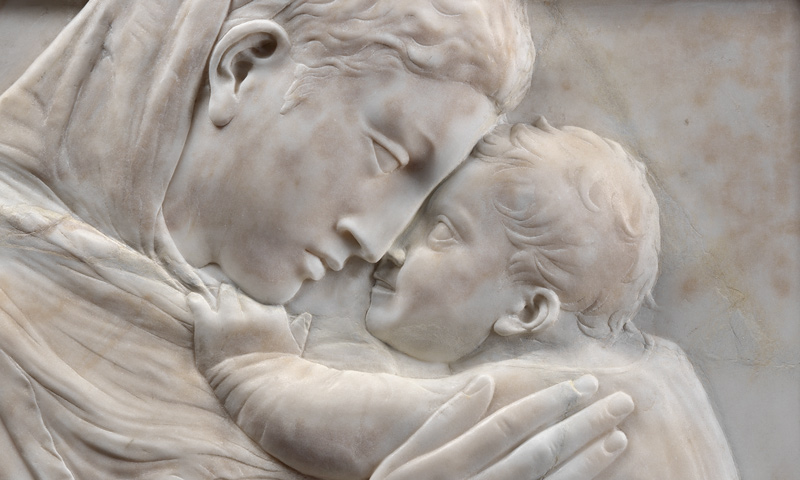
Cover: Donatello, Madonna col Bambino (Madonna Pazzi), about 1420-1425, Staatliche Museen zu Berlin – Preußischer Kulturbesitz. Skulpturensammlung und Museum für Byzantinische Kunst. Photo Antje Voigt