Basquiat
In Italian
from 25 September 2027
to 23 January 2028
- Piano nobile
- Daily 10.00-20.00Thursdays until 23.00
- Ticket required
- Amici di Palazzo Strozzi: free
Fondazione Palazzo Strozzi presents a major exhibition devoted to Jean-Michel Basquiat, one of the most influential figures in twentieth-century art. The exhibition offers a new interpretation of his work, focusing on his relationship with art history and with Italy’s cultural and historical legacy, from antiquity to the Renaissance
Curated by Dieter Buchhart and Anna Karina Hofbauer, the project brings together over 60 works from major international public and private collections. It highlights Basquiat’s connection with Italy in particular, understood both as a source of cultural and iconographic influences and as a destination he visited several times during his life.
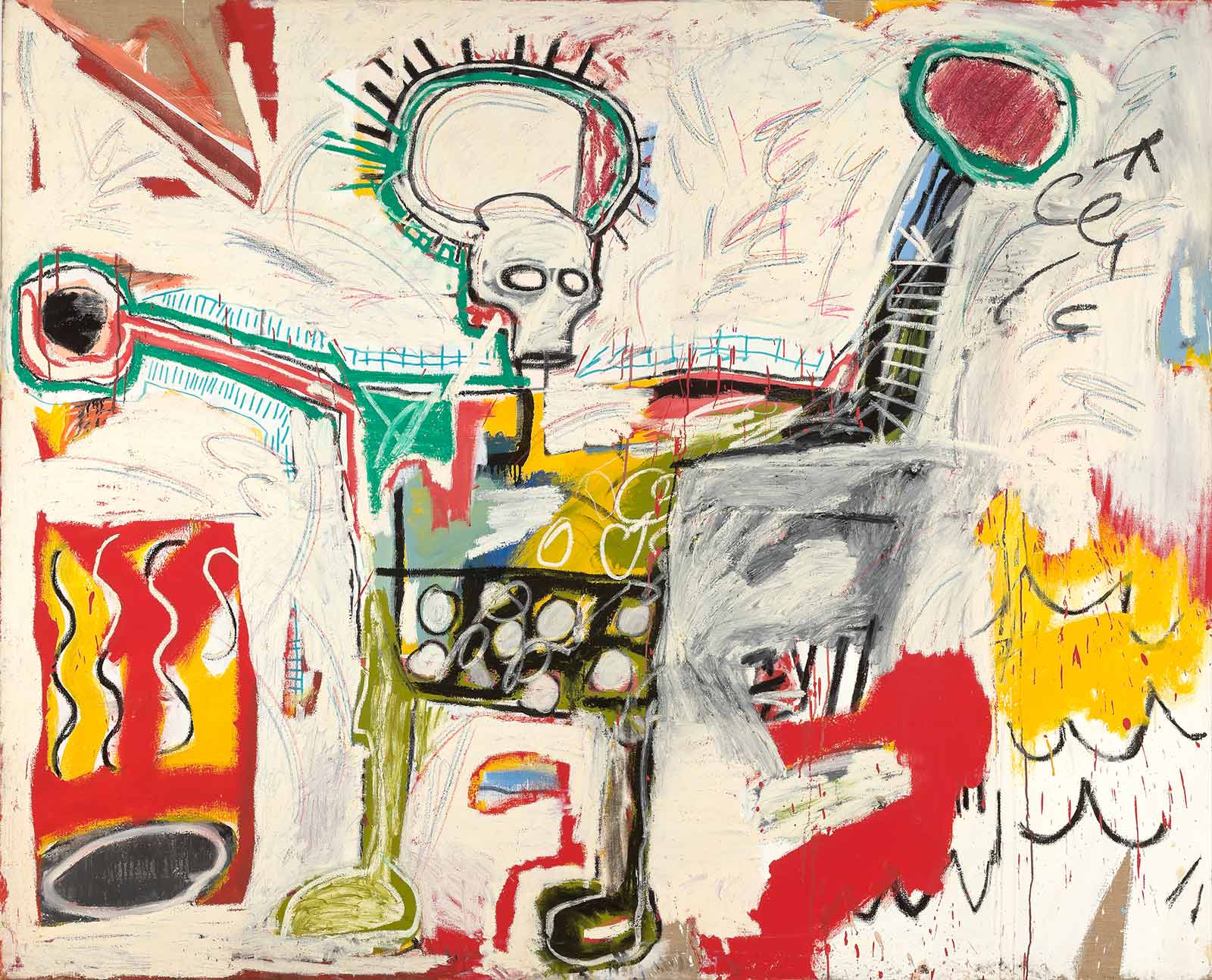
Figures, models and masters of the past, from ancient Rome to Leonardo da Vinci and from ancient Egypt to Galileo Galilei, are reinterpreted through Basquiat’s unmistakable visual language, which interweaves historical references with contemporary resonances. Recurring symbols, anatomical figures, graphic marks, pictograms and words form layered images open to multiple levels of interpretation. Different periods and cultures are thus brought into dialogue, generating visual and conceptual collisions that heighten the contemporary relevance of his social and political reflections on issues such as identity, racism, social inequality and capitalism.
Born in Brooklyn to a Puerto Rican mother and a Haitian father, Basquiat began his artistic career at a very young age in late-1970s New York, rapidly establishing himself on the international art scene before his untimely death in 1988, at the age of just 27. Beginning in Downtown Manhattan, where he first worked as a graffiti artist, creating poetic and text-based interventions in public space, Basquiat developed a powerful and radically innovative figurative language capable of merging the visual codes of New York’s streets with a vast cultural heritage. His compositions draw inspiration from everyday life and popular culture, including comic strips, children’s drawings and advertising, while also incorporating cultures and artistic traditions from different periods and geographical contexts, from Aztec and African art to Greco-Roman and Renaissance art.
Basquiat’s direct relationship with Italy began at the start of his international career. He first travelled to Modena in 1981 for his first European solo exhibition at the Galleria Emilio Mazzoli, returning to the city the following year to produce the celebrated Modena Paintings series and to take part in the group exhibition Transavanguardia: Italia/America. Over the course of several visits to Italy, he also spent time in Rome, where he held a solo exhibition at the Galleria Mario Diacono, and in Florence, encountering first-hand the artistic and historical heritage of antiquity and the Renaissance.
Cover: Jean-Michel Basquiat, Untitled, 1982. Rotterdam, Collection Museum Boijmans Van Beuningen, 3047 (MK) © Estate of Jean-Michel Basquiat. Licensed by Artestar, New York.